Lecture 4 The Aftermath of the Crisis
Today I want to talk about the aftermath of the crisis. To recap, I talked last time about the most intense phase of the crisis, in late 2008 and early 2009: financial panic both in United States and in other industrialized countries; the threat to the stability of the entire global financial system; the Federal Reserve in its lender of last resort role, working with others, provided short-term liquidity to help stabilize key institutions and markets.
One of the conclusions we can now draw, having looked at the history, is that rather than being some ad hoc and unprecedented set of actions, the Fed’s response was very much in keeping with the historic role of central banks, which is to provide lender of last resort facilities in order to calm a panic. What was different about this crisis was that the institutional structure was different. It was not banks and depositors; it was broker- dealers and repo markets, money market funds and commercial paper. But the basic idea of providing short-term liquidity in order to stem a panic was very much what Bagehot envisioned when he wrote Lombard Street in 1873.
I have been focusing on the Fed’s actions, but the Fed did not work alone. We worked in close coordination with other U.S. authorities and foreign authorities. For example, the Treasury was engaged after the Congress approved the so-called TARP legislation. The Treasury was in charge of making sure that banks had sufficient capital and the U.S. government took an ownership position in many banks that was essentially temporary. Most of those have now been reversed. The FDIC played an important role. In particular, the $250,000 deposit insurance limits were raised essentially to infinity for transaction accounts. And the FDIC also provided guarantees to banks that wanted to issue corporate paper of up to three years maturity in the marketplace. For a fee, the FDIC guaranteed those issuances so that banks could get longer-term funding. So this was a collaborative effort between the Fed and other U.S. agencies.We also worked closely with foreign agencies. I mentioned last time the currency swaps, in which the Fed gave dollars to foreign central banks in exchange for their own currencies. And those foreign central banks took the dollars and, at their own risk, made dollar loans to financial institutions that required dollar funding. We also, of course, continue to be in close touch with finance ministers and regulators around the world as we try to coordinate to deal with the crisis.Putting out the most intense phase of the fire was not really enough. There has been a continuing effort to strengthen the financial and banking systems. For example, in a quite successful action that I think was very constructive, the Fed, working with the other banking agencies, led stress tests of the nineteen largest U.S. banks in the spring of 2009. This was not long after the most intense phase of the crisis. In an unprecedented way, we disclosed to the markets what the financial positions were of the major banks. Those stress tests, which confirmed that our banks could survive even a return to worse economic and financial conditions, created a great deal of confidence in investors and allowed banks to raise a great deal of private capital and, in many cases, to replace the government capital they received during the crisis. The process of stress testing has continued. Just a couple of weeks ago, the Fed led another round of stress tests, a very demanding set of stress tests. Our banks did quite well. They have raised a great deal of capital even since 2009. In many ways, they are in a stronger position in terms of capital than they were even prior to the crisis.
So these are steps that are being taken to try to get the banks back into full lending mode. It is still in progress, but restoring the integrity and the effectiveness of the financial system is obviously part of getting us back to a more normal economic situation.
Let me say a few words about the lender of last resort programs. As I have already argued at some length, the programs did appear to be effective. They arrested runs on various types of financial institutions and they restored financial market functioning. The programs, which were instituted primarily in the fall of 2008, were mostly phased out by March 2010. And they were phased out really in two different ways.
First, some of the programs just came to an end. But more often, in making loans to provide liquidity to financial institutions, the Fed would charge an interest rate that was lower than the crisis rate, the panic rate, but higher than normal interest rates. And so as the financial system calmed down and rates came back down to more normal levels, it was no longer economically or financially attractive for the institutions to keep borrowing from the Fed, and so the program wound down quite naturally. We did not have to shut them down; they basically disappeared on their own.
The financial risks that the Federal Reserve took in the lender of last resort programs were quite minimal. As I have described, lending was mostly short term. It was backed by collateral in most cases. In December 2010, we reported to Congress all the details involved in twenty-one thousand loans that the Fed made during the crisis. Of those twenty- one thousand loans, zero defaulted. Every single one was paid back. So even though the objective of the program was stabilizing the system rather than profit making, the taxpayers did come out ahead on those loans.
So that was lender of last resort activity. That was the fire hose to put out the fire of the financial crisis. But even though the crisis was contained, the impact on the U.S. and global economies was severe. And new actions were needed to help the economy recover. Remembering that the two basic tools of central banks are lender of last resort policy and monetary policy, we now turn to the second tool, monetary policy, which was the primary tool used to try to bring the economy back after the trauma of the financial crisis.
Conventional monetary policy involves management of the overnight interest rate called the federal funds rate. By raising and lowering the short-term interest rate, the Fed can influence a broader range of interest rates. That, in turn, affects consumer spending, purchases of homes, capital investment by firms, and the like, and that provides demand for the output of the economy and can help stimulate a return to growth.
Just a few words on the institutional aspects. Monetary policy is conducted by the Federal Open Market Committee, which meets in Washington eight times a year. During the crisis, it sometimes also held video conferences. When we have a meeting of the FOMC, there are nineteen people sitting around the table. There are the seven members of the Board of Governors, who are appointed by the president and confirmed by the Senate. And then there are the twelve presidents of the twelve Federal Reserve banks, each of whom is appointed by the board of directors of that regional Reserve Bank and then confirmed by the Board of Governors in Washington. So there are nineteen people around the table. We all participate in the monetary policy discussion.
When it comes time to vote, the system is a little bit more complicated. At any given meeting only twelve people are able to vote. The seven members of the Board of Governors have a permanent vote at every meeting. The president of the New York Federal Reserve Bank also has a permanent vote, which goes back to the beginning of the system and the fact that New York remains the financial capital of the United States. For the other four votes, there is a rotation system: each year, four of the eleven other Reserve Bank presidents vote, and then the next year, a different set of four vote. So again, there is a total of twelve votes in any given meeting or on any given decision on monetary policy but the entire group participates in the discussions.
Figure 30 shows the federal funds rate, the short-term interest rate that is a normal tool the Fed uses for monetary policy. You can see that at the end of Chairman Greenspan‘s term and the beginning of my term in 2006, we were in the process of raising the federal funds rate in an attempt to normalize monetary policy after having easier policy earlier in the decade in order to help the economy recover from the 2001 recession. Butin 2007, as problems began to appear in the subprime mortgage market, the Fed began to cut interest rates. You can see on the right side of the graph that interest rates were sharply reduced. And by December 2008, the federal funds rate was reduced to a range of between 0 and 25 basis points. A basis point is one-hundredth of 1 percent, so 25 basis points means one-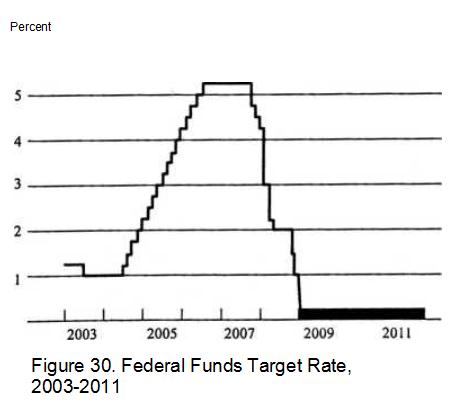
quarter of 1 percent. By December 2008, the federal funds rate was reduced basically to zero. It cannot be cut any more, obviously.
So, as of December 2008, conventional monetary policy was exhausted. We could not cut the federal funds rate any further. And yet, the economy clearly needed additional support. Into 2009, the economy was still contracting at a rapid rate. We needed something else to support recovery, and so we turned to less conventional monetary policy. The main tool we have used is what we in the Fed call the large-scale asset purchases, or LSAPs, known in the press and elsewhere as quantitative easing, or QE. These large-scale asset purchases were an alternative way of easing monetary policy to provide support to the economy.
So how does this work? To influence longer-term rates, the Fed began to undertake large- scale purchases of Treasury and GSE mortgage-related securities. So, just to be clear here, the securities that the Fed has been purchasing are government-guaranteed securities, either Treasury securities, that is, government debt of the United States, or Fannie and Freddie securities, which were guaranteed by the U.S. government after Fannie and Freddie were taken into conservatorship.
There have been two major rounds of large-scale asset purchases, one announced in March 2009, often known as QE1, and another announced in November 2010, known as QE2. There have been some additional variations since then, including a program to lengthen the maturity of our existing assets, but these were the two biggest programs in terms of their size and their impact on the Fed's balance sheet. Taken together, these actions increased the Fed's balance sheet by more than two trillion dollars.
Figure 31 shows the asset side of the Fed's balance sheet, to help us see the effects of the large-scale asset purchases. The bottom layer is the traditional securities holdings. To be absolutely clear, even under normal circumstances the Fed always owns a substan-tial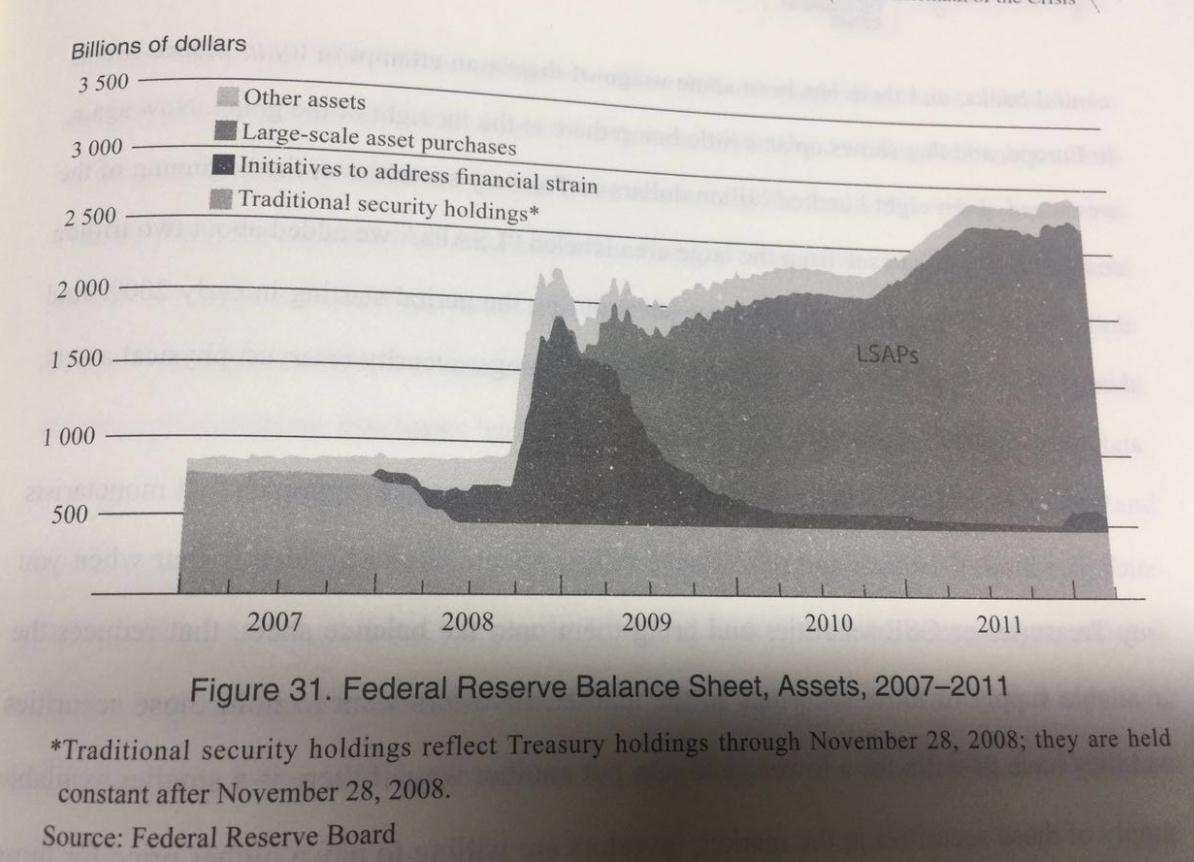
amount of U.S. Treasuries. We owned more than eight hundred billion dollars?worth of U.S. Treasuries before the crisis began. It is not as though we began buying them from scratch. We have always owned a significant amount of these securities. So the bottom layer shows the baseline from which we started.
What else appeared on the Fed's balance sheet on the assets side during this period? The dark segment just above the traditional securities holdings represents assets acquired or loans made during the crisis period. You can see that in late 2008, our loans outstanding to financial institutions and to some other programs rose very sharply. But you can also see that as time passed, and certainly by early 2010, those initiatives to address financial strength had been greatly reduced.
If you look at the far right, you see a little bump recently. That is the currency swaps. We instituted and extended swap agreements with the European Central Bank and other major central banks, and there has been some usage of that in an attempt to try to reduce strains in Europe, and that shows up as a little bump there at the far right of the graph. Now again, we owned about eight hundred billion dollars in Treasury securities at the beginning of the crisis. But as you can see from the large area labeled "LSAPs",we added about two trillion dollars in new securities to the balance sheet during the period starting in early 2009. And then at the top, you have other assets, a variety of things, security reserves, physical assets, and other miscellaneous items.
Why were we buying these securities? This is, by the way, an approach that monetarists such as Milton Friedman and others have talked about. The basic idea is that when you buy Treasuries or GSE securities and bring them onto the balance sheet, that reduces the available supply of those securities in the market. Investors want to hold those securities and they have to settle for a lower yield. Or, put another way, if there is a smaller available supply of those securities in the market, investors are willing to pay a higher price for those securities, which is the inverse of the yield.
So by purchasing Treasury securities, bringing them onto our balance sheet, and reducing the available supply of those Treasuries, we effectively lowered the interest rate of longer-termed Treasuries and GSE securities as well. Moreover, to the extent that investors no longer having available Treasuries and GSE securities to hold in their portfolios, to the extent that they are induced to move to other kinds of securities, such as corporate bonds, that also raises the prices and lowers the yields on those securities. And so the net effect of these actions was to lower yields across a range of securities. And as usual, lower interest rates have supportive, stimulative effects on the economy.
So this was really a monetary policy by another name: instead of focusing on the short-term rate, we were focusing on longer-term rates. But the basic logic of lowering rates to stimulate the economy is really the same.
You might ask, "The Fed is buying two trillion dollars' worth of securities. How do we pay for that?"The answer is that we paid for those securities by crediting the bank accounts of the people who sold them to us. And those accounts at the banks showed up as reserves that the banks would hold with the Fed. So the Fed is a bank for the banks. Banks can hold deposit accounts with the Fed, essentially, and those are called reserve accounts. And so as the purchases of securities occurred, the way we paid for them was basically by increasing the amount of reserves that banks had in their accounts with the Fed.
Figure 32 shows the liability side of the Fed's balance sheet. Of course, assets and liabilities including capital have to be equal. So the liability side had to rise to nearly three trillion dollars, as you can see. As you look at this, look first at the bottom layer, which is currency, Federal Reserve notes in circulation. Sometimes you hear that the Fed is printing money in order to pay for the securities we acquire. But as a literal fact, the Fed is not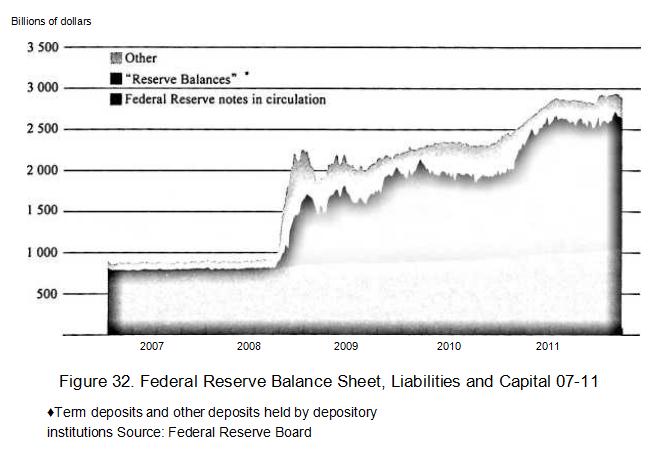
printing money to acquire the securities. And you could see it from the balance sheet here. That layer is basically flat; the amount of currency in circulation has not been affected by these activities.
What has been affected is the layer above that, reserve balances. Those are the accounts that commercial banks hold with the Fed, assets to the banking system and liabilities to the Fed, and that is basically how we pay for those securities. The banking system has a large quantity of these reserves, but they are electronic entries at the Fed. They basically just sit there. They are not in circulation. They are not part of any broad measure of the money supply. They are part of what is called the monetary base, but they certainly are not cash. Then the top layer is other liabilities, including Treasury accounts and a variety of other things that the Fed does. We act as the fiscal agent for the Treasury. But the two main items you can see are the notes in circulation and the reserves held by the banks.
So what do the LSAPs or the quantitative easing, what does it do? We anticipated when we took these actions that we would be able to lower interest rates, and that was generally successful. For example, thirty-year mortgage rates have fallen below 4 percent, which is a historically low level, but other interest rates have fallen as well. The interest rates corporations have to pay on bonds, for example, have fallen, both because the underlying safe rates have fallen but also because the spreads between corporate bond rates and Treasury rates have fallen as well, reflecting greater confidence in the financial markets about the economy. And lower long-term rates, in my view and in the Fed's analysis, have promoted growth and recovery.
Nonetheless, the effect on housing has been weaker than we hoped. We have gotten mortgage rates down very low. You would think that would stimulate housing, but the housing market has not yet recovered.
The Fed has a dual mandate; we always have two objectives. One of them is maximum employment, which we interpret to mean trying to keep the economy growing and using its full capacity, and low interest rates are a way of stimulating growth and trying to get people back to work. The second part of our mandate is price stability, low inflation. We have been quite successful in keeping inflation low. It has been a help that Volcker, in particular, and also Greenspan made it much easier for me because they had already persuaded markets that the Fed was committed to low inflation, and the Fed has built up a lot of credibility over the past thirty years or so. As a result, markets have been confident that the Fed will keep inflation low; inflation expectations have stayed low. And except for some swings up and down related to oil prices, overall, inflation has been quite low and stable.
At the same time, while we have kept inflation low, we have also made sure that inflation has not gone negative. Particularly around the time of QE2, in November 2010, there was concern that inflation had been falling. It was well below normal levels. The concern was we might get into negative inflation or deflation. Deflation has been a big problem for Japan's economy now for quite a few years, and I talked about deflation also in the context of the Great Depression. We certainly wanted to avoid deflation. So monetary ease also guarded against the risk of deflation by making sure that the economy did not get too weak.
One more comment on large-scale asset purchases. A lot of people do not distinguish between monetary and fiscal policy. Fiscal policy is the spending and taxation tools of the federal government. Monetary policy has to do with the Fed's management of interest rates. These are very different tools. And in particular, when the Fed buys assets as part of an LSAP or QE program, this is not a form of government spending. It does not show up as government spending because we are not actually spending money. What we are doing is buying assets, which at some point will be sold back to the market, and so the value of those purchases will be earned back. In fact, because the Fed gets interest on the securities we hold, we actually make a very nice profit on these LSAPs. What we have done over the past three years is transfer about two hundred billion dollars in profits to the Treasury. That money goes directly to reducing the deficit. So these actions are not deficit-increasing; they are in fact significantly deficit-reducing.
So a major tool we used when we ran out of room to lower short-term interest rates was LSAPs, asset purchases. The other tool we have used to some extent is communication about monetary policy. To the extent that we can clearly communicate what we are trying to achieve, investors can better understand our objectives and our plans, and that can make monetary policy more effective. The Fed has taken a lot of steps to become more transparent about monetary policy to try to make sure people understand what we are trying to accomplish.
For example, four times a year, after two-day FOMC meetings, I give a press conference and answer questions about monetary policy decisions. This is a new thing for the Fed in terms of trying to explain what our policies are.
Another recent step that we took in communicating our policies more clearly was to put out a statement that described our basic approach to monetary policy and, in particular, for the first time gave a numerical definition of price stability. Many central banks around the world already have a numerical definition of price stability, and in our statement we said that, for our purposes, we were going to define price stability as 2 percent inflation. And so, the markets will know that over the medium term, the Fed will try to hit 2 percent inflation, even as it also tries to hit its objectives for growth and employment.
Finally, the Fed has also begun to provide guidance to investors and the public about what we expect to do with the federal funds rate in the future, given how we currently see the economy. So, given how we currently see the economy, we tell the market something about where we think the rates are going to go. To the extent that the market better understands our plans, that is going to help reduce uncertainty in financial markets. And to the extent that our plans are, in some sense, more aggressive than the market anticipated, we will also tend to ease policy conditions.
The recession---the period of contraction, which was very severe--officially came to an end. There is a committee called the National Bureau of Economic Research, which officially designates the beginning and end dates of recessions. I was a member of that committee before 1 became a policymaker. And they determined that this recession began in December 2007 and ended in June 2009, so it was a long recession. When they say the recession ended, what that means basically is not that things are back to normal; it just means that the contraction has stopped and the economy is now growing again. So we have been growing now for almost three years, averaging about 2.5 percent a year. But as I described, we are still some distance from being back to normal. So when we say the economy is no longer in recession, we do not mean that things are great. We just mean that we are no longer actually contracting; we are now growing.
Figure 33 gives a picture of the sluggish economic recovery. The darker line in the graph shows the path of real GDP since 2007. The shaded area shows the period of the recession according to the National Bureau of Economic Research. You can see that it begins in December 2007, and real GDP begins to decline during that period. In mid-2009, the recession is officially over. And you can see that, since then, the darker line has been moving up as the real economy has been expanding.
But you can also see a comparison. Suppose that the economy had been recovering since mid-2009 at the average pace of previous recoveries in the postwar period. That average recovery is shown by the lighter line. You can see that this recovery has been slower than the average recovery in the post-World War II period. It is actually even worse than that, in a way, because this was the most severe recession in the post-World War II period. And so you would expect that recovery might be a little quicker as the economy comes back to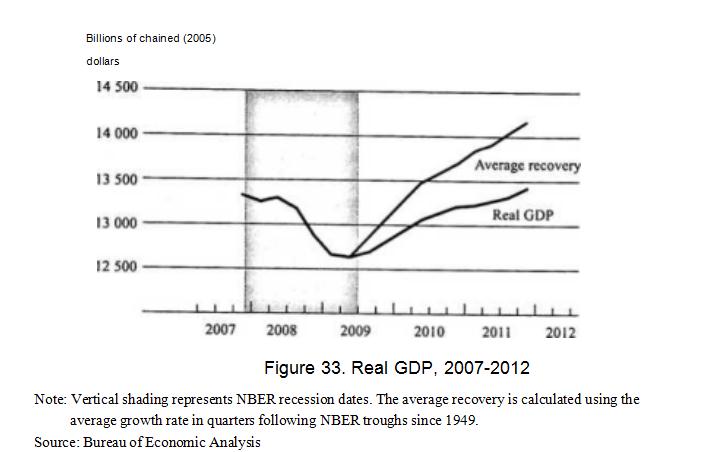
its normal level, but in fact it has been actually slower in terms of growth than previous postwar recoveries.
An implication of the sluggish recovery is only very slow improvement in the unemployment rate. In figure 34, you can see the unemployment rate rising sharply during the recession period, peaking at around 10 percent, and then slowly coming down to its current value of about 8.3 percent. That is still quite high. Figure 35 shows single-family housing starts. As I discussed, housing starts collapsed even before the recession began. Of course, that was a trigger of the recession. And you see how very sharply construction declined. If you look at the most recent year or two, you see that there have been a few little wiggles, but the housing market has not come back.
So this is one answer to the question, why has this recovery been more sluggish than normal? One reason certainly is the housing market. In a usual recovery, housing comes back. It is an important part of the recovery process. Construction workers get put back to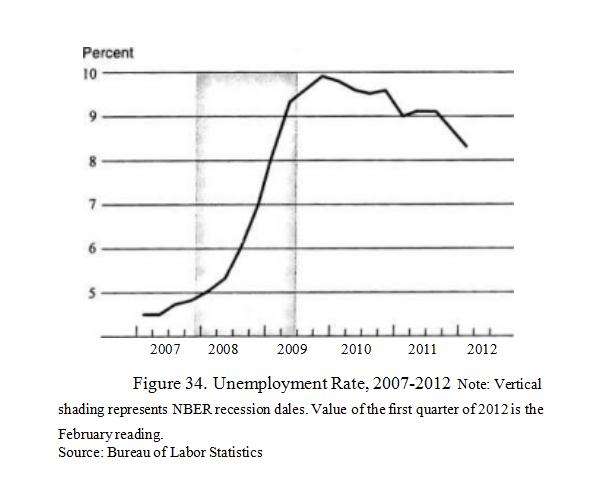
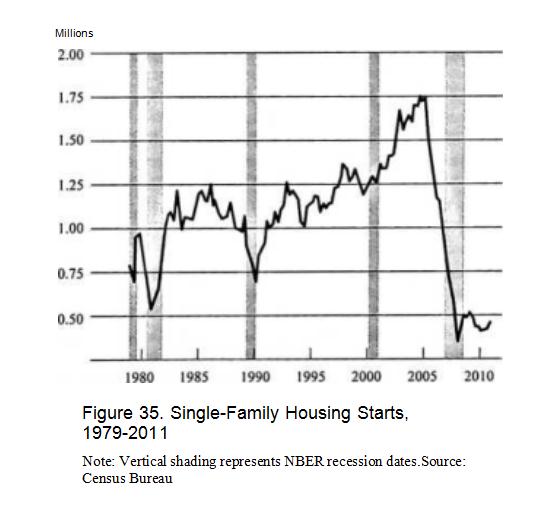
work, related industries such as furniture and appliances begin to expand, and that is part of the recovery process. But in this case, we have not seen that. Why not?
There are still a lot of structural factors in the housing market that are preventing a more robust recovery. On the supply side, we still have a very high excess supply of housing, a high vacancy rate. Figure 36 shows the percentage of housing units in the United States that are vacant, such as foreclosed homes or homes where the seller is unable to find a buyer. You can see that the vacancy rate peaked at more than 2.5 percent during the recession. It has come down some but is still well above normal levels. There are a lot of homes on the market, and that produces excess supply and falling house prices.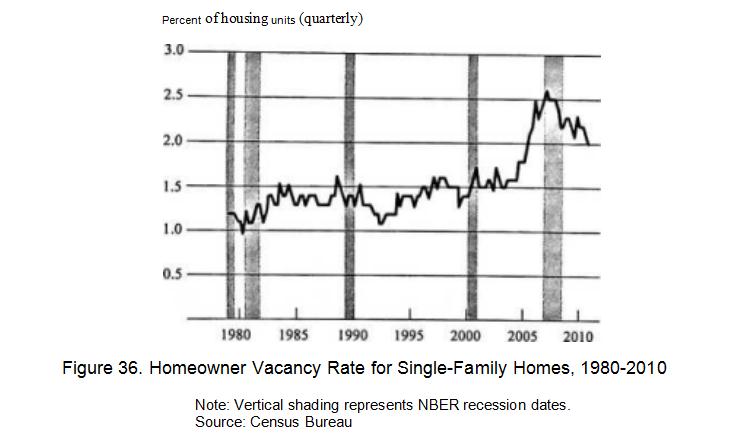
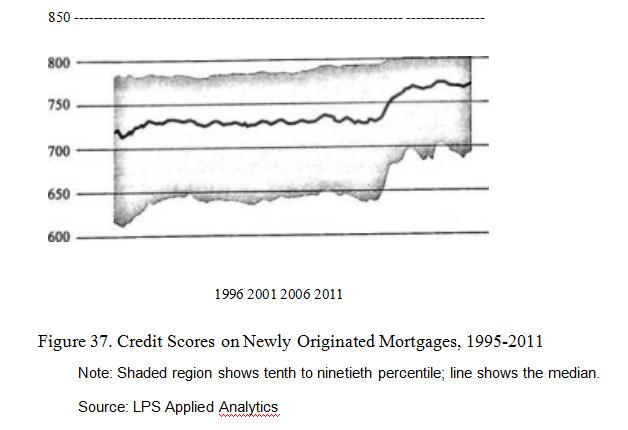
On the demand side, you might think that a lot of people would be buying houses these days because houses are really affordable. Prices are down a lot; mortgage rates are low. And so if you are able to buy a house, you can get an awful lot of house for your monthly payment now, compared to a few years ago. But being able to take advantage of that affordability requires, among other things, that you get a mortgage. Figure 37 shows what is happening in the mortgage market. The bottom line shows the tenth percentile and the top line the ninetieth percentile of credit scores of people receiving mortgages. And you can see that before the crisis, people with relatively low credit scores were able to get mortgages. But since the crisis, you can see the whole bottom part of the shaded area has been cut away, implying that people with lower credit scores --and 700 is not a terrible credit score-are unable to get mortgages. In general, conditions have been much tighter for obtaining mortgages. So even though housing is very affordable and monthly payments are affordable, a lot of people are unable to get mortgages.
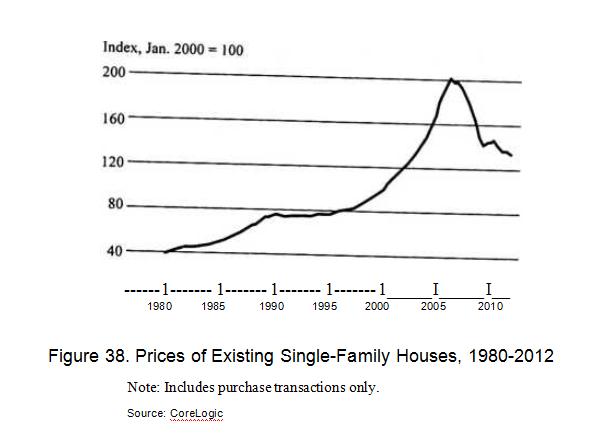
So, with a lot of excess supply in the housing market and with a lot of people unable to get mortgage credit or afraid to get back into the housing market, house prices have been declining, as shown in figure 38. Recently we have seen some leveling off, but so far not much evidence of an upturn. Declining house prices mean it is not profitable to build new houses, and so construction has been quite weak. And more broadly, when existing
homeowners see their house prices decline, it may mean they cannot get home equity lines of credit or they just feel poorer. And so that affects not just their housing behavior, but also their willingness and ability to buy other business services. So the declines in housing prices and, to some extent, also stock prices are part of the reason consumers have been cautious and less willing to spend.
Housing was a major cause of this crisis and recession. The other major factor was the financial crisis and its impact on credit markets. And that is another reason the recovery has been somewhat slower than we would have hoped. As I have discussed, the U.S. banking system is stronger than it was three years ago. The amount of capital in the banking system over the past three years has increased by something like three hundred billion dollars, a very significant increase. And generally speaking, we are seeing credit terms getting a bit easier. We are seeing expansions in bank lending in a lot of categories. So there is certainly some improvement in banking and credit.
Nevertheless, there are still scenarios where credit remains tight. I have already talked about mortgages: if you have anything less than a perfect credit score, it is very difficult to get a mortgage these days. And other categories such as small businesses have also found it difficult to get credit. It is well known that small business is an important creator of jobs, so the inability to start a small business or to get credit to expand a small business is one of the reasons job creation has been relatively slow.Another aspect of financial and credit markets has to do with the European situation. Following the financial crisis in Europe, which was very severe alongside of ours, there is now a second stage in which the solvency issues of a number of countries, the concerns about whether countries such as Greece and Portugal and Ireland can pay their creditors, have led to stressed financial conditions in Europe. And those have negatively affected the United States by creating risk aversion and volatility in the financial markets.
A lesson worth drawing from this is that monetary policy is a powerful tool but it cannot solve all the problems that there are. And in particular, what we are seeing in this recovery is a number of structural issues relating, for example, to the housing market, to the mortgage market, to banks, to credit extension, and of course to the European situation, where other kinds of policies--whether fiscal policies or housing policies or whatever they may be-are needed to get the economy going again. So the Fed can provide stimulus. It can provide low interest rates. But monetary policy by itself cannot solve important structural, fiscal, and other problems that affect the economy.
This is all rather discouraging. Again, it has taken a while to get back to where we are, and we are still a long way from where we would like to be. So let me say a few words about the long run. We did have, of course, a major trauma. The crisis was very deep. We have a lot of people who have been unemployed for a long time. About 40 percent or more of all the unemployed had been unemployed for six months or more. And if you are unemployed for six months or a year or two years, your skills will start to atrophy and your ability to get reemployed will decline. So that clearly is a problem. And then there are many other issues that the United States was facing even before the crisis, such as federal budget deficits, and those have not gone away. In fact, they have gotten somewhat worse through the recession. So clearly, there have been some real headwinds for our economy.
That said, I think it is important to understand that our economy has faced many short-term shocks in the past, and some not so short-term, but it has always been able to recover. We have a lot of strengths in this economy. It is, of course, the largest economy in the world; between 20 and 25 percent of all output in the world is produced in the United States, even though we have something like 6 percent or less of the world's population. And the reason that we are so productive has to do with the diverse set of industries we have; our entrepreneurial culture, which still is clearly the best in the world; the flexibility of our labor markets and our capital markets; and our technology, which remains one of our very strongest points. Increasingly, technology has been driving economic growth. And with some of the finest universities and research centers in the world as magnets for talented people from around the world, the United States has been very successful in the research and development area. So, that has also been a source of ongoing growth and innovation in our economy. Again, we have weaknesses and the financial crisis highlighted a few, but we have also tried to address them by strengthening our financial regulatory system.
I find figure 39 interesting, to put in perspective what I have been discussing during these lectures. The dashed line shows a constant growth rate of a little over 3 percent in real terms. This is a log scale, so the straight line means a constant growth rate. And you can see that, going back to 1900, the United States economy has grown reasonably consistently at around 3 percent annually for more than a century. In the 1930s, you can see the big swing as the Great Depression pulled actual output below the trend line. And then you can see the movement above the trend line during World War n . But look what happened after World War II : we went right back to the trend line. There were recessions and booms and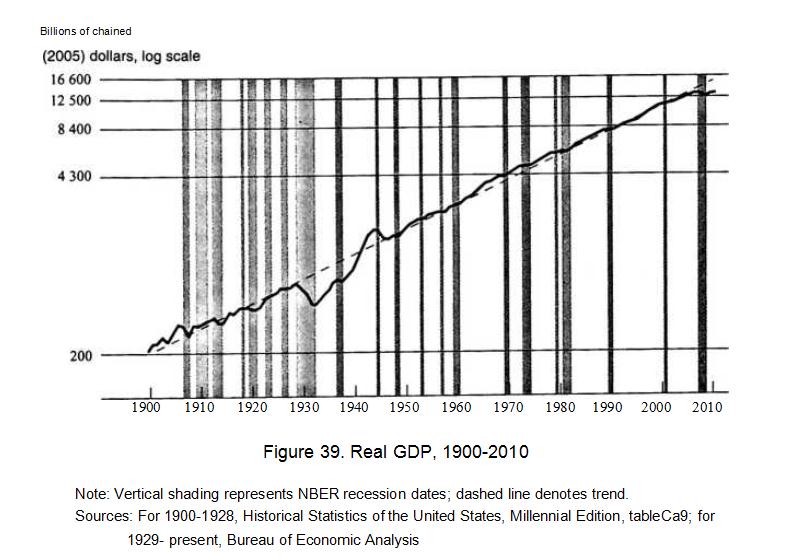
busts in the postwar period, but growth remained fairly close to the trend line. Now, if you look to the very far right, you see where we are today: we are below the trend line. There are debates about whether that de-cline is permanent. But looking at history, I think there is a reasonable chance that the U.S. economy will return to a healthy annual growth rate somewhere in the 3 percent range. There are factors to take into account, such as changes in our population growth rate, the aging of our population, and so on. But broadly speaking, what this graph shows is that, over long periods, our economy has been successful in maintaining long-term economic growth.
I will say a few words about regulatory changes. In the last couple of lectures I discussed the vulnerabilities in both the private and public sectors in the financial system. On the public side, the crisis revealed many weaknesses in our regulatory system. We saw what happened with Lehman Brothers and AIG, the effects of the “too big to fail”problem on our system, and more generally, the problem of the lack of attention to the broad stability of the system as opposed to individual parts of the system.
There has been a very substantial amount of financial regulatory reform in the United States since 2008, and the biggest piece of legislation is the so-called Dodd-Frank Act.?This legislation, officially named the Wall Street Reform and Consumer Protection Act, which was passed in the summer of 2010, was a comprehensive set of financial reforms addressing many of the vulnerabilities that I discussed earlier.
Now, what were these vulnerabilities? One was the fact that there was nobody watching over the whole system, nobody looking at the entire financial system to spot risks and threats to overall financial stability. So, one of the main themes of the Dodd-Frank Act is to try to create a systemic approach, where regulators look at the whole system and not just individual components of it. Among the tools to do that is a newly created council called the Financial Stability Oversight Council (FSOC), of which the Fed is a member, which helps regulators coordinate. We meet regularly in this council and discuss economic and financial developments and talk about ways that we can look at the whole system and try to avoid various kinds of problems.
Moreover, the Dodd-Frank Act gave all regulators responsibility to take into account broad systemic implications of their own individual regulatory and supervisory actions. And in particular, the Federal Reserve has greatly restructured our supervisory divisions so that we are looking now very comprehensively at a whole range of financial markets and financial institutions. As a result, now we have a big picture that we did not have before the crisis.
I mentioned in my discussion of vulnerabilities the many gaps in the financial system. There were important firms, such as AIG, for example, but others as well, that had no significant comprehensive oversight by any regulatory agency. The Dodd-Frank Act provides a fail-safe in that the FSOC can designate, by vote, any institution it views as not being adequately regulated to come under the supervision of the Federal Reserve. That process is going on now. So there will not be any more large, complex, systemically critical firms that have no oversight. Likewise, the FSOC can also designate the so-called financial market utilities like a stock exchange or some other major exchange to be supervised by the Fed and other agencies. So those gaps are being closed. We will not have the situation that we had before the crisis.
Another set of problems had to do with too big to failand dealing with firms that are systemically critical. The approach to dealing with too big to fail or systemically critical institutions is two-pronged. On the one hand, under Dodd-Frank, large, complex, systemically important financial institutions are going to face tougher supervision regulation than other firms. The Federal Reserve, working with international regulators, has established higher capital requirements that these firms will be subject to, including surcharges for the very largest and most systemic firms. Rules like the Volcker Rule, which prohibits bank affiliates from taking risky bets on their own accounts, will try to reduce the riskiness of large firms. Stress tests will be conducted. Dodd-Frank requires that large firms be stress tested by the Fed once a year and conduct their own stress tests once a year. So we will be comfortable, or at least more comfortable, that these firms can withstand a major shock to the financial system.
Now, one part of tackling “too big to fail”is to bring these large, complex firms under more stringent scrutiny: more supervision, more capital reserves, more stress tests, more restrictions on their activities. But the other side of tackling “too big to fail”is, well, failing. In the crisis, the Fed and the other financial agencies faced a terrible choice of either trying to prevent some large firms such as AIG from failing, which was a bad choice because it ratified “too big to fail”and meant that the firms were not adequately punished for the risks they took, or letting them fail and potentially destabilize the whole financial system and the economy. So that is the “too big to fail”problem. The only way to solve that problem, in the end, is to make it safe for a big firm to fail. One of the main elements of the Dodd-Frank Act is what is called the “orderly liquidation authority,”which has been given to the FD1C. The FDIC already has the authority to shut down a failing bank, and it can do that quickly and efficiently, typically over the weekend. And depositors are made whole. The FDIC’s ability to do that has prevented panics and bank runs since the 1930s. The idea here is that the FDIC will do something similar, but for large, complex firms, which obviously is much more difficult. But in cooperation with the Fed, and with regulators from other countries in the case of multinational firms, work is under way to prepare. So should it happen that a large firm comes to the brink of insolvency and cannot find a solution--cannot find new capital, for example--the Fed’s ability to intervene the way we did in 2008 has been taken away. Legally, we cannot do that anymore. The only option we will have is to work with the FDIC to safely wind down the firm, and that will ultimately reduce or, we hope, eliminate the “too big to fail”problem.
There are many other aspects of the Dodd-Frank Act. Another vulnerability I discussed was the exotic .financial instruments, derivatives and so on, that concentrated risk. There is a whole set of new rules that require more transparency about derivatives positions, standardization of derivatives, and trading of derivatives through third parties called central counter parties. The idea here is to take derivatives and those transactions out of the shadows, to make them available and visible to both the regulators and the markets to avoid a situation like we saw during the crisis.
The Federal Reserve did not do as good a job as it should have in protecting consumers on the mortgage front. So the Dodd-Frank Act creates a new agency, called the Consumer Financial Protection Bureau, which is meant to protect consumers in their financial dealings, and that would include things like protections on the terms of mortgages, for example.
So there is quite a variety of aspects of Dodd-Frank. It is a large and complex bill, and there has been a lot of complaining about the fact that it is large and complex. The regulators are doing their best to implement these rules in a way that will be effective and, at the same time, minimize the cost to the industry and to the economy. That is difficult, but it is an ongoing process. We do that through an extensive process of putting out proposed rules, gathering comments from the public, looking at those comments, making changes to the rules, and so on. It is an iterative process through which we put in place these regulatory standards. And again, it is still very much under way.
Let me conclude by saying a couple of things about the future. Central banks, not just in the United States but around the world, have been through a very difficult and dramatic period, which has required a lot of rethinking about how we manage policy and how we manage our responsibilities with respect to the financial system. In particular, during much of the World War n period, because things were relatively stable, because financial crises were things that happened in emerging markets and not in developed countries, many central banks began to view financial stability policy as a junior partner to monetary policy. It was not considered as important. It was something to which they paid attention, but it was not something to which they devoted many resources.
Obviously, based on what happened during the crisis and the effects we are still feeling, it is now clear that maintaining financial stability is just as important a responsibility as maintaining monetary and economic stability. And indeed, this is a return to where the Fed came from in the beginning. Remember that the reason that Fed was created was to try to reduce the incidence of financial panics; financial stability was the original goal in creating the Fed. So now we have come full circle.
Financial crises will always be with us. That is probably unavoidable. We have had financial crises for six hundred years in the Western world. Periodically, there are going to be bubbles or other instabilities in the financial system. But given what the potential for damage is now, as we have seen, it is really important for central banks and other regulators to do what we can, first, to anticipate or prevent a crisis, but also, if a crisis happens, to mitigate it and to make sure the system is strong enough to make it through the crisis intact.
Again, we began by noting the two principle tools of central banks, serving as lender of last resort to prevent or mitigate financial crises, and using monetary policy to enhance economic stability. In the Great Depression, as I described, those tools were not used appropriately. But in the recent episode, the Fed and other central banks used these tools actively. I should also say that there has been a great convergence, that other major central banks have followed policies very similar to that of the Fed. And in any case, I believe that by using these tools actively, we avoided much worse outcomes in terms of both the financial crisis and the depth and severity of the resulting recession. A new regulatory framework will be helpful. But again, it is not going to solve the problem. The only solution in the end is for us regulators and our successors to continue to monitor the entire financial system and to try to identify problems and to respond to them using the tools that we have.
Dialogues
Student: In the first lecture, you touched on the Main Street versus Wall Street divide, and this has been in the back of my mind throughout the lecture series. You have talked about the importance of educating the public on monetary policy. And although this lecture series has definitely demystified the Fed for me, I think it has really been Wall Street, not Main Street, that has been tuning in. So, given how unpopular bank bailouts were among many Americans struggling to pay their mortgages who donn really understand the importance of financial stability, do you ever see Americans reconciling these differences?
Chairman Bernanke: You are right. Some of the same conflicts that we saw in the nineteenth century, we see echoes of them today as well. I do not have a simple answer to that question. As you know, the Fed has done more outreach?the press conferences and other kinds of tools --to try to explain what we did and what we are doing. Clearly, the Fed is very accountable. We testify frequently, not just myself but other members of the Board or Reserve Bank presidents. We give speeches. We appear at various events and so on.
It is inherently difficult because the Fed is a complicated institution. And as you have seen in these four lectures, these are not simple issues. But all we can do, I think, is to do our best and hope that our educators, our media, and so on will begin to carry the story and help people understand better. It is a difficult challenge and it does reflect a tension in American feelings about central banks ever since the beginning.
student: Earlier you mentioned that the Fed had several ways to unwind thelarge-scale asset purchases, including selling them back into the market. What guarantees that investors will be willing to buy them back in the future?
Chairman Bernanke: We have essentially three separate types of tools that we can use, any one of which by itself would allow us to unwind our policies. But taken together, they give us a lot of comfort.
First, we have the ability to pay interest on the reserves that banks hold with us. So, when the time comes for the Fed to raise interest rates, we can do so by raising the rate of interest we pay to banks on those reserves. Banks are not going to lend out the reserves at a rate lower than they can earn at the Fed. And so that will lock up those reserves, raise interest rates, and serve to tighten monetary policy. So, that one tool by itself, even if our balance sheets stayed large, could tighten monetary policy.
The second tool we have is what are called draining tools. Basically, we have various ways that we can drain the reserves from the banking system and replace them with other kinds of liabilities even as the total amount of assets on our balance sheet remains unchanged.
The third and final option is either to let the assets run off as they mature or to sell them. These are Treasury securities and government-guaranteed securities. It is certainly possible that the prevailing interest rate when we sell those securities will be higher than it is today. In other words, we will have to pay a higher interest rate in order to make investors willing to acquire them. But actually, that will be part of the process. That will be a time when we are trying to raise interest rates.
It will be the reverse of what we did when we bought them. At that point, we will be trying to raise interest rates in order to exit from the easy policy to a policy that will allow the economy to grow in a low-inflationary way.
So, I do not think there is any danger that investors will not buy the assets.
They will certainly buy them at a higher interest rate, and that would be part of the objective of reducing the balance sheet to tighten financial conditions, so as to avoid inflation concerns in the future.
Student: I read an article that laid out a plan to allow homeowners who have been on time with their mortgage payments to refinance at the current lower rates as a way to protect them from their housing prices dropping. I was wondering whether you have heard of plans like that and what sort of involvement the Fed would have or whether that would fall to the Consumer Financial Protection Bureau.
Chairman Bernanke: There are some programs like that, one in particular is called the HARP program, which is run by the GSEs, Fannie and Freddie, and by their regulator, the Federal Housing Finance Agency. In this program, if you are underwater in your mortgage--in other words, if you owe more on your mortgage than your house is worth--you still may be able, under this program, if your mortgage is held by Fannie or Freddie, to refinance at a lower interest rate, which will reduce your payments. That program is under way and being expanded. It does not necessarily work if your mortgage is being held by a bank because they are not part of this program, but they may choose voluntarily to do it. But you might be out of luck if your mortgage is not held by Fannie or Freddie.
So, there are programs like that. The Fed is not involved in them. Our job has been to keep mortgage rates low and hope that we can help homeowners. But programs like that, which allow people to get lower payments, obviously are going to be helpful to those people because they will face less financial stress, and there would be a smaller chance that they will end up being delinquent on their mortgages.
Student: You mentioned in your lecture the dangers of deflation from the Great Depression and more recently in Japan. And one of the arguments for maintaining a target inflation rate above zero is to provide a cushion against the possibility of deflation. Yet in the last two recessions in the United States, there has been a significant fear of deflation, causing the Fed to keep monetary policy very accommodative in the beginning of the last decade and even more so at this point. Do you think that 2 percent is enough of a cushion to prevent deflation?
And have you considered higher inflation target rates?
Chairman Bernanke: That is a great question, and there has been a lot of research on it. It seems that the international consensus is around 2 percent. Almost all central banks that have a target have either a 2 percent target or a 1-3 percent target or something similar. And there is a trade-off here, because, on the one hand, you want to have it above zero, as you say, in order to avoid or reduce deflation risk. But on the other hand, if inflation is too high, it is going to create problems for markets. It is going to make the economy less efficient. And so there is a trade-off in which one level of inflation gives you at least some reasonable buffer against deflation, but it is not so high that it makes markets work less well And so again, the international consensus has been around 2 percent, and Student: You mentioned that one of the biggest lessons you learned from the recent financial crisis is that monetary policy is powerful but it cannot solve all the problems, especially structural problems. What are the effective tools that can be used to solve these structural problems in housing and financial and credit markets?
Chairman Bernanke: It depends on the particular set of problems. In the case of housing, the Federal Reserve staff wrote a white paper that analyzed a number of the issues, not just foreclosures, but also what to do with vacant houses, how to get more appropriate mortgage origination conditions, and issues of that sort. We did not come out with a list of actual recommendations because that is really up to Congress and to other agencies to determine. But we did go through a whole list of possible approaches.
But housing is a very complex problem, and there are many different things that could be done to try to make it work better. And indeed, looking forward, given the problems with Fannie and Freddie, we have some very big decisions to make as a country about what our housing finance system is going to look like in the longer term.
In Europe, for example, there has been a very complex problem. We have been in close discussions with our European colleagues. They have taken a number of steps. Right now they are talking about a so-called firewall, how much money they are going to contribute to provide protection against the possibility of contagion if some country defaults or fails to pay its bills.
Each of these issues has its own approach. In the labor market, we have the problem of people who have been out of work for a long time. Obviously, one of the best ways to deal with that would be some form of training, increasing skills. So you could just go down the list. And basically, anything that makes our economy more productive, more efficient, and deals with some of these long-term issues related to our fiscal problems, those are all things that would help. And the fact that the Fed is doing what we can to try to support the recovery should not mean that no other policies are undertaken. I think it is important that we look across the entire government and ask what kinds of constructive steps can be taken to make our economy stronger and to help the recovery be more sustainable.
Student: You mentioned that the Fed is doing what it can to sustain the recovery, but with unemployment at 8.3 percent and the housing market very sluggish and the problems in Europe, what other tools does the Fed have to address other issues that might arise in the future-say, if unemployment starts to rise, or the housing recovery gets worse, or Portugal, Spain, and Italy default?
Chairman Bernanke: Oh, my! You will cost me a night's sleep now. What I described today is basically what the toolkit is for the Federal Reserve and other central banks. We still have lender of last resort authority. It has been modified in some ways by the Dodd-Frank Act-strengthened in some ways and reduced in some ways. So between that and our financial regulatory authority, we want to make sure our financial system is strong. And we have worked particularly hard to make sure that we do everything we can to protect our financial system and our economy from anything that might happen in Europe. So, that whole set of tools is still available and in play should there be any new problems in financial markets.
On the monetary side, we do not have any completely new monetary tools, but we have our interest-rate policies, and we can continue to use monetary policy as appropriate as the outlook changes to try to achieve the appropriate recovery while still maintaining price stability, which is the other half of the Federal Reserve mandate.
So we have these two basic sets of tools. We will have to continue to evaluate where the economy is going and use them appropriately. We do not have lots of other tools. And that is why I was saying earlier that we really need an effort across different parts of the government, and indeed the private sector, to do what can be done to get our economy back on its feet.
Student: You spoke a lot about the economic recovery and that, although it is painfully slow, there is a clear recovery happening. What are the key indicators that you and the Federal Reserve are looking at that would suggest that the private sector has begun self-sustaining this economic recovery and that the Fed may begin to tighten monetary policy?
Chairman Bernanke: That is a great question. First, one set of indicators that has been looking better lately and we have been paying a lot of attention to is developments in the labor market, jobs, unemployment rate, unemployment insurance claims, hours of work, all of those indicators suggest that the labor market is strengthening. And indeed, employment is one of our two objectives. So clearly, that is something we would like to see sustained. We would like to see a continued improvement in the labor market.
As I discussed in the third lecture, it is much more likely that the improvement in the labor market will be sustained if we also see increases in overall demand and overall growth. So we will continue to look at indicators of consumer spending and consumer sentiment, capital plans, capital expenditures, indicators of optimism on the part of firms, those kinds of things, to see where production and demand are going to go. And then, of course, as always, we have to look at inflation and be comfortable that price stability will be maintained and that inflation will be low and stable. So those are the things we will be looking at, and there is no simple formula. But as the economy strengthens and becomes more self-sustaining, then at some point the need for so much support from the Fed will begin to diminish.