Lecture 3 The Federal Reserve's Respone to the Financial Crisis
Today I want to talk about the Federal Reserve’s response to the financial crisis. In the last couple of lectures I mentioned a key theme, the two main responsibilities of central banks---financial stability and economic stability. Let me turn it around and talk about the two main tools. For financial stability, the main tool the central banks have is lender of last resort powers by providing short-term liquidity to financial institutions, replacing lost funding. Central banks, as they have for a number of centuries, can help calm a financial panic. For economic stability, the principal tool is monetary policy; in normal times, that involves adjusting short-term interest rates.
Today 1 will discuss the intense phase of the financial crisis in 2008 and 2009, and so 1 will focus primarily on the lender of last resort function of the central bank. I will come back to monetary policy in the final lecture when we talk about the aftermath and recovery.
Last time 1 talked about some of the vulnerabilities in the financial system that transformed into a crisis the decline in housing prices, which by itself seemed no more threatening than the decline in dot-com stock prices. Because of these vulnerabilities, the decline in housing prices led to a very severe crisis. The vulnerabilities I talked about last time were private-sector vulnerabilities, including the excessive debt taken on perhaps because of the period of the Great Moderation; very important, the banks?inability to monitor their own risks; excessive reliance on short-term funding (which, as a nineteenth- century bank would tell you, makes it vulnerable to a run as short-term funding is pulled away), and increased use of exotic financial instruments such as credit default swaps and others that concentrated risk in particular companies or in particular markets. Those were the vulnerabilities in the private sector.
The public sector had its own vulnerabilities, including gaps in the regulatory structure. Important firms and markets did not have adequate oversight. Where there was adequate oversight, at least by law, sometimes the supervisors and regulators did not do a good enough job. For example, not enough attention was paid to forcing banks to do a better job of monitoring and managing their risks. And finally, an important gap we have really begun to look at since the crisis is that, with individual agencies looking at different parts of the system, not enough attention was being paid to the stability of the financial system as a whole.
Let me talk for a moment about another important public-sector vulnerability, the so- called government-sponsored enterprises (GSEs) Fannie Mae and Freddie Mac. Fannie Mae and Freddie Mac are nominally private corporations (they have shareholders and a board) but they were established by Congress in support of the housing industry. Fannie and Freddie, as they are called, do not make mortgages. You cannot go to Fannie‘s headquarters and get a mortgage. Instead, they are the middleman between the originator of the mortgage and the ultimate holder of the mortgage. If you are a bank and you make a mortgage loan, if you like you can sell the mortgage to Fannie or Freddie. They will, in turn, take all the mortgages they purchase and put them together into mortgage-backed securities (MBSs) to sell to investors. A mortgage-backed security is just a security that is a combination of hundreds or thousands of underlying mortgages. That process is called securitization. Fannie and Freddie pioneered this basic approach to getting funding from mortgages. In particular, when the GSEs, Fannie and Freddie, sell their mortgage-backed securities, they provide guarantees against credit loss. So if the underlying mortgages in those MBSs go bad. Fannie and Freddie make the investor whole. Now, Fannie and Freddie were permitted to operate with inadequate capital. So they were particularly at risk in a situation with a lot of mortgage losses. They did not have enough capital to make good on their guarantees. Although many aspects of the financial crisis were not anticipated, this one was. Going back for at least a decade before the crisis, the Fed and many other people said that Fannie and Freddie just did not have enough capital and that they were a danger to the stability of the financial system. What made the situation even worse was that Fannie and Freddie, besides selling mortgage-backed securities to investors, also purchased on their own account large amounts of mortgage-backed securities, both their own and some that were issued by the private sector. They made profits from holding those mortgages but, to the extent that those mortgages were not insured or protected, Fannie and Freddie were vulnerable to losses and, without adequate capital, they were at risk.
It was not just the house price boom and bust but also the mortgage products and practices that went along with the house price movements that were particularly damaging and that were important triggers of the crisis. There were a lot of exotic mortgages, by which I mean nonstandard mortgages (standard mortgages are thirty-year prime fixed-rate mortgages). All different other kinds of mortgages were being offered, often to people with weaker credit. One feature that many of these mortgages shared was that, in order for them to be repaid, house prices had to keep increasing. For example, you might be a borrower who would get an adjustable-rate mortgage (ARM), where the initial interest rate was 1 percent, which meant that you could afford the payment for the first year or two. Now, after two years, the mortgage interest rate might go up to 3 percent, then after four years, 5 percent, and then higher and higher. In order to avoid that, at some point you would have to refinance into a more standard mortgage. As long as house prices were going up, creating equity for homeowners, it was possible to refinance. But once home prices stopped rising?and by 2006 they were already declining quite sharply--rather than having built equity, borrowers found themselves underwater. They could not refinance and found themselves stuck with increasing payments on their mortgages.
Some examples of bad mortgage practices include:
?interest-only (IO) adjustable-rate mortgages (ARMs);
?option ARMs (which permit borrowers to vary the size of monthly payments);
?long amortizations (payment periods greater than thirty years);
?negative amortization ARMs (initial payments do not even cover interest costs); and
?no-documentation loans.
Most of these bad mortgage practices shared the feature that they reduced monthly payments early in the mortgage but allowed mortgage payments to rise over time. Take, for example, an option ARM, which is an adjustable-rate mortgage with the option for borrowers to vary how much they pay. They could pay less than the full amount owed each month and what they did not pay just got rolled back into the mortgage. The other common feature of bad mortgage practices, such as no-doc loans, was that there was very little underwriting, which means very little analysis to make sure that the borrower was creditworthy and was able to make the payments on the mortgage.
Figure 22 shows two advertisements from the period that can illustrate some of the issues. I like the one on the right. We removed the name of the company. Let’s look at
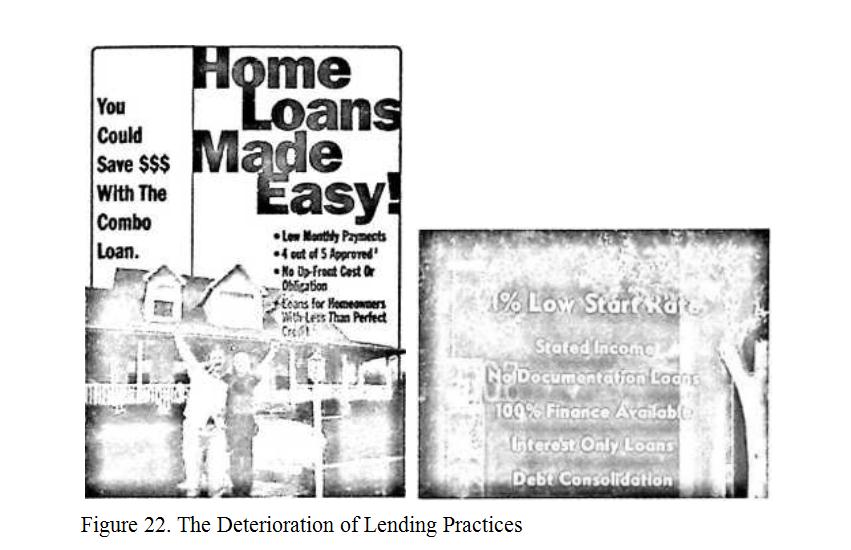
the features it is offering. A “1 percent low start rate” the start rate is what you pay t first year; it does not tell you about the next year. “stated income”means that you tell thl company what your income is, and they write it down; that is all the checking they do. “no documentation” is self-explanatory. A “100 percent finance”means that no down payment is required. “Interest-only loans”means that you pay the interest but you do not have to pay any principle back. And “debt consolidation”is an interesting arrangement that allows you to go to the mortgage company and say, “well, not only do I want to borrow money to buy the house, but also I want to add in all my credit card debt and everything else I owe, and put that into one big mortgage payment, and I’ll pay for that with the 1 percent start rate.” Obviously, these are some very problematic practices.
Mortgage companies, banks, savings and loans, and a variety of other institutions originated these nonprime mortgages, but where did these mortgages wind up? How were they financed? Some of them were kept on the balance sheet of the mortgage originator, but many or even most of these exotic or subprime mortgages were packaged in securities and sold off into the market.
Some mortgage-backed securities were relatively simple. If the mortgages were sold to Fannie and Freddie, they had to meet Fannie and Freddie’s underwriting standards. Fannie and Freddie would combine them into mortgage-backed securities and sell them with a guarantee, as I discussed. Those are relatively simple securities made up of basically just hundreds or thousands of underlying mortgages.
But some of the securities that were being created were very complex and very hard to understand. An example would be a collateralized debt obligation (CDO). This would often be a security that combines mortgages and other types of debt together in one package. And it could be sliced in different ways so that one investor could buy the safest part of the security and another investor could buy the riskiest part. These securities were very complicated and required a lot of analysis.
One reason that many investors were willing to buy these securities was because they had the reassurance that the rating agencies, whose job is to rate the quality of bonds and other securities, gave triple-A ratings to many of these securities--essentially saying that these securities were very safe and one did not have to worry about their credit risk. Many of these securities were sold to investors, including pension funds, insurance companies, foreign banks, and even, in some cases, wealthy individuals. But the financial institutions that created these securities often retained some of them as well. For example, sometimes they would create an accounting fiction, an off-balance-sheet vehicle, which would hold these securities and finance itself using cheap short-term funding such as com-mercial paper. So, some of the securities went to investors and some of them stayed with the financial institutions themselves.
In addition, we had companies, such as AIG, that were selling insurance. They were using various kinds of credit derivatives to say, “Pay us a premium and if the mortgages in your mortgage-backed security go bad, we will make you whole.”That makes the security triple-A rated. Of course, these practices made the underlying securities no better, and basically they created a situation where risks could be spread throughout the system.
Figure 23 is a diagram showing how a subprime mortgage securitization might work. On the left, where the box reads “low-quality mortgages,”you might have a mortgage company or a thrift company making loans. This thrift or mortgage company does not care too much about the quality of the loan because the company is going to sell it anyway. So they sell the mortgages to large financial firms, which in turn take those mortgages, and maybe other securities as well, and combine them into a security that is essentially an amalgamation of all the underlying mortgages and other securities.
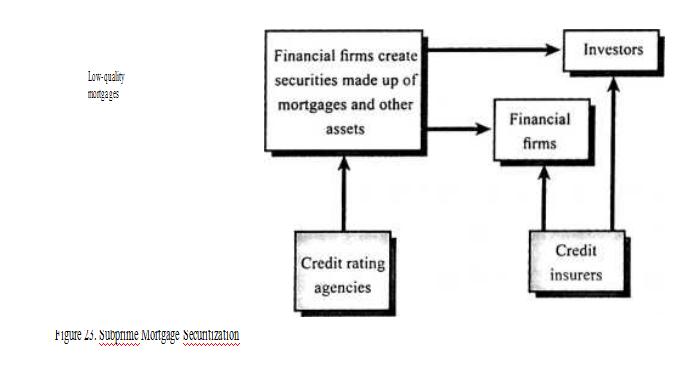
Now, the financial firm that created the security might negotiate with the credit-rating agency, asking, “what do we have to do to get a triple-A rating?”There would be negotiations and discussion and, in the end, the security would be rated triple-A. The financial firm could then cut up the security in different ways or sell it as is to investors such as pension funds. But again, financial firms kept many of these securities on their own books or in related investment vehicles. And finally, on the right in the figure, you have credit insurers such as AIG and other mortgage insurance companies that for a fee provided insurance in case the underlying mortgages went bad. So this is the basic structure of the securitization process. I have seen complete flowcharts and they are incredibly complex. This is a very simplified version, but the basic idea is there.
As you recall, a financial crisis or panic occurs when you have any kind of financial institution that has illiquid assets (long-term loans, for example) but liquid short-term liabilities (deposits, for example). In a classic bank panic, if bank depositors lose faith in the quality of the assets held by the bank, they run and pull out their money; the bank cannot pay off everybody because it cannot change their loans into cash fast enough; and so the run on the bank is self-fulfilling. The bank will either fail or have to dump all of its long-term assets quickly in the market and take big losses.
The crisis of 2008?009 was a classic financial panic but in a different institutional setting: not in a bank setting but in a broader financial market setting'. As house prices fell in 2006 and 2007, for the reasons 1 described, people who had subprime mortgages were not able to make the payments. It was increasingly evident that more and more were going to be delinquent or default, and that was going to impose losses on the financial firms, the investment vehicles they had created, and also on credit insurers like AIG. Unfortunately, the securities were extremely complex and financial firms?monitoring of their own risks was not sufficiently strong. The problem was not just the losses. If you put together all the subprime mortgages in the United States and assumed they were all worthless, the total losses to the financial system would be about equivalent to one bad day in the stock market: they were not very big. The problem was that they were distributed throughout different securities and different places and nobody really knew where they were and who was going to bear the losses. So that created a lot of uncertainty in the financial markets.
As a result, wherever you had short-term funding, whether commercial paper or other types of short-term funding, the lenders refused to lend. We had all kinds of funding that was not deposit insured; it was so-called wholesale funding, which came from investors and other financial firms. Whenever there was doubt about a firm, as in a standard bank run, the investors, the lenders, and the counterparties would all pull back their money quickly for the same reason that depositors would pull their money out of a bank that was thought to be having trouble. So there was a whole series of runs, which generated huge pressures on key financial firms as they lost their funding and were forced to sell their assets quickly, and many important financial markets were badly disrupted. During the Depression, thousands of banks failed, but almost all of them, at least in the United States, were small banks (some larger banks failed in Europe). The difference in 2008 was, in addition to the many small banks that failed, there were also intense pressures on quite a few of the largest financial institutions in the United States.
Let’s look at some of the firms that came under intense pressure. Bear Steams, a broker- dealer, came under intense pressure in the short-term funding markets in March 2008 and was sold to JPMorgan Chase with Fed assistance on March 16. Things calmed down a bit after that, and over the summer there was some hope that the financial crisis would moderate. But then in the late summer, things really began to pick up.
On September 7, 2008, Fannie and Freddie clearly were insolvent. They did not have enough capital to pay the losses on their mortgage guarantees. The Federal Reserve worked with Fannie and Freddie’s regulator and with the Treasury to determine the size of the shortfall, and over that weekend, the Treasury with the Fed’s assistance placed those firms into a form of limited bankruptcy called a conservatorship. At the same time, the Treasury got authorization from Congress to guarantee all of Fannie and Freddie’s obligations. So, the firms were in a partial bankruptcy but the U.S. government now guaranteed their mortgage-backed securities. So that protected those investors. That had to be done or else it would have been an enormous intensification of the crisis because investors all over the world held literally hundreds of billions of dollars?worth of those securities.
In the middle of September, Lehman Brothers, a broker-dealer, had severe losses. It came under great pressure and could not find anybody either to buy it or to provide it with capital. And so on September 15th, it filed for bankruptcy. On the same day, Merrill Lynch, another big broker-dealer, was acquired by the Bank of America, basically saving the firm from potential collapse.
The next day, on September 16th, A1G, the largest multidimensional insurance company in the world, which had been selling credit insurance, came under enormous attack from people demanding cash either through margin requirements or through short-term funding. The Fed provided emergency liquidity assistance for AIG and prevented the firm from failing.
Washington Mutual was one of the biggest thrift companies, a big provider of subprime mortgages. It was closed by regulators on September 25th. After parts of the company were split off, JPMorgan Chase acquired this company as well. On October 3rd, Wachovia, one of the five biggest banks in the United States, came under serious pressure and was acquired by Wells Fargo, another large mortgage provider.
All the firms I am talking about were among the top ten or fifteen financial firms in the United States, and similar things were happening in Europe. So, this was not a situation where only small banks were affected. Here we had the largest, most complex international financial institutions on the brink of failure.
Let’s review the lessons from the Great Depression, which I discussed in the first lecture. First, the Fed did not do enough to stabilize the banking system in the 1930s, and so the lesson there is that in a financial panic, the central bank has to lend ffeely, according to Bagehot’s principle, to halt runs and to try to stabilize the financial system. Second, the Fed did not do enough to prevent deflation and contraction of the money supply in the 1930s, so the second lesson from the Great Depression is that you need to have accommodative monetary policy to help the economy avoid a deep recession. So, heeding those lessons, the Federal Reserve and the federal government took vigorous actions to stop the financial panic, working domestically with other agencies and internationally with foreign central banks and governments.
Now, one aspect of the crisis that, I think, does not receive enough attention is that it was global. In particular, Europe as well as the United States was suffering very severely from the crisis. But it was also a very impressive example of international cooperation.
On October 10, 2008, as it happened, there was a previously scheduled meeting in Washington of the G7 industrial countries, the seven largest industrial countries, and the central bank governors and the finance ministers of those seven countries met in Washington. Now, I will tell you a deep, dark secret: these big, high-profile international meetings are usually a terrible bore because much of the work is done in advance by the staff. We have a discussion, but the communique has already been written by the staff and in most cases what happens at the meeting is fairly routine. This was not one of those boring meetings. We essentially tore up the agenda and discussed what we should do. How should we work together to stop this crisis that was threatening the global financial system? In the end we came up with a statement of principles that was written from scratch, based on some Fed proposals. Among those principles were that we would work together to prevent the failure of any more systemically important financial institutions. This was after Lehman Brothers had failed. We would make sure that banks and other financial institutions had access to funding from central banks and capital from governments. We would work to restore depositor confidence and investor confidence, and then we would cooperate as much as possible to normalize credit markets. This was a global agreement, and the following week, the United Kingdom was the first to announce a comprehensive program to stabilize its banking system. The United States announced major steps to put capital into our banks, and so on. So a lot happened in the next couple of days after this meeting.
To show you how effectively this worked, figure 24 graphs the interest rate charged on overnight loans between banks, the interbank interest rate. Normally, the overnight interest rate between banks is extremely low, far less than 1 percent, because banks need some place to park their money overnight and they have a lot of confidence that it is safe to lend to another large bank overnight. As you can see, starting in 2007 banks lost confidence in one another, which is shown by the increase in the rates they charged one another to make loans. For example, in 2007, you begin to see the pressures as house prices began
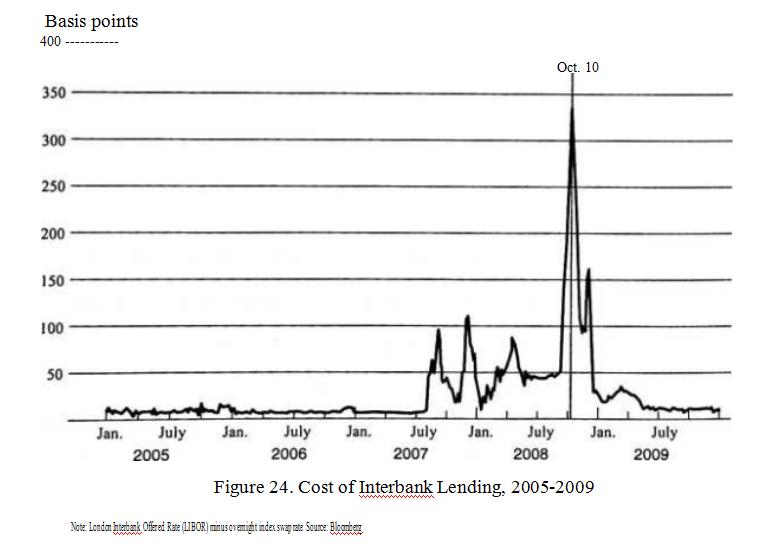
to fall and there were increasing concerns about the quality of mortgage securities and the financial soundness of firms. In March 2008, you can see another little peak around the time Bear Steams was forced to sell itself. That does not look like much, in comparison to what happened later, but that was a very difficult period. It was a period of quite sharp movements in financial markets and in funding markets. Now, look what happened in response to Bear Steams’s liquidity problems. There was an enormous spike in interbank market rates, and probably not much lending was taking place even at those high rates. This indicated that suddenly there was no trust whatsoever even between the largest financial institutions because nobody knew who was going to be next, who was going to fail, who was going to come under funding pressure.
Look what happened after the international announcements. Within a few days we began to see a reduction in funding pressure, and by early January there was an enormous improvement in the funding pressures in the banking system. This is a great example of international cooperation and it illustrates the point that this was not just a U.S. phenomenon, it was not just U.S. policy, it was not just the Federal Reserve. It really was a global cooperative effort, particularly between the United States and Europe.
The Fed played an important role, however, in providing liquidity, in making sure that the panic was controlled. I will talk briefly about this in general and then 1 will present two case studies that will illustrate some of the issues. The Federal Reserve has a facility called the discount window, which it uses routinely to provide short-term funding to banks, maybe a bank that finds itself short of funding at the end of the day. It wants to borrow overnight. It has collateral with the Fed. Based on that collateral, it can borrow overnight at the discount rate, which is the interest rate the Fed charges. So the discount window, which allows the Fed to lend to banks, is always operative. No extraordinary steps were needed to lend to banks. The Fed always lends to banks. We did make some modifications in order to reassure banks about the availability of credit. And to get more liquidity into the system, we extended the maturity of discount window loans, which were normally overnight loans. We made them longer-term and we had auctions of discount window funds, in which firms bid on how much interest they would pay. The idea there was by having a fixed amount that we were auctioning, we would at least assure ourselves that we got a lot of cash into the system. The point here is that the discount window, which is the Fed’s usual lender of last resort facility lending to banks, was operative and we used it aggressively to make sure that the banks had access to cash to try to calm the panic.
But our financial system is a lot more complicated than the one that existed when the Fed was created in 1913. We have many different kinds of financial institutions in markets now. And as 1 said, the crisis was like an old-fashioned bank crisis, but it happened to all different kinds of firms and in different institutional contexts. So the Fed had to go beyond the discount window. We had to create a whole bunch of other programs, special liquidity and credit facilities that allowed us to make loans to other kinds of financial institutions, on the Bagehot principle that providing liquidity to firms that are suffering from loss of funding is the best way to calm a panic. All these loans were secured by collateral. We were not taking chances with taxpayers?money. But the cash was going not just to banks but also more broadly into the system. Again, the purpose of this was to enhance the stability of the financial system and get credit flows moving again. Let me emphasize that this is the traditional lender of last resort function of central banks that has been around for hundreds of years. What was different was that it took place in a different institutional context than just the traditional banking context.
Flere are some of the institutions and markets that we addressed through our special programs. Banks were covered by the discount window. But another class of financial institutions, broker-dealers (financial firms that deal in securities and derivatives), were also facing very serious problems. They included Bear Steams, Lehman Brothers, Merrill Lynch, Goldman Sachs, Morgan Stanley, and others. The Fed provided cash or short-term lending to those firms on a collateralized basis as well. Commercial paper borrowers received assistance, as did money market funds. In the modern financial system, not just mortgages but also auto loans, credit cards, and all different kinds of consumer credit are funded through the securitization process. For example, a bank might take all of its credit card receivables, bundle them together into a security, and then sell them in the market to investors, much as mortgages are sold, and that is called the asset-backed securities market. The asset-backed securities market essentially dried up during the crisis, and the Fed created some new liquidity programs to help get it started again, which we were successful in doing.
I should mention that although the Fed’s lending to banks was totally standard lending through the normal discount window, these other types of lending required the Fed to invoke emergency authority. There is a clause, 13(3), in the Federal Reserve Act that says that under unusual and exigent circumstances (basically, in an emergency), the Fed can lend to entities other than just banks. This authority had not been used by the Fed since the 1930s. But in this particular case, with all these other problems emerging in different institutions and in different markets, we invoked this authority and used it to help stabilize a variety of different markets.
Let me give you a case study that will help you understand what we did and how it helped the economy. I want to talk a little bit here about money market funds. Money market funds are basically investment funds in which you can buy shares, and the funds take your money and invest it in short-term liquid assets. Money market funds historically almost always maintain a one-dollar share price. So they are very much like a bank, and they are often used by institutional investors such as pension funds. A pension fund with thirty million dollars in cash probably would not put that into a bank because that much money is not insured; there is a limit to how much deposit insurance covers.
So what a pension fund might do instead of putting the cash in a bank would be to put the money into a money market fund, which promises one dollar for each dollar put in, plus a little bit of interest on top, and invests in very short-term, safe, liquid assets. So it is a reasonably good way to manage your cash if you are an institutional investor.
As I said, money market shares do not have deposit insurance, but the investors who put their money into a money market fund expect that they can take their money out at any time, dollar for dollar. So they treat it like a bank account, basically. The money market funds in turn have to invest in something, and they tend to invest in short-term assets such as commercial paper. Commercial paper is a short-term debt instrument issued typically by corporations, short-term in that its maturity is ninety days or less. A nonfinancial corporation might issue commercial paper to allow it to manage its cash flow. It might need some short-term money to meet its payroll or to cover its inventories. So ordinary manufacturing companies such as GM or Caterpillar would issue commercial paper to get cash to manage their daily operations. Financial corporations, including banks, would also issue commercial paper to get funds that they could then use to manage their liquidity positions and to make loans to the private economy. Figure 25 is a diagram of how a money market fund works. On the left, you see investors investing their excess cash in the money market fund. The money market fund buys commercial paper, which is basically a funding source for both nonfinancial businesses, such as manufacturers, and for financial companies that would lend it to other borrowers.
What happened to this arrangement during the 2008 crisis? Lehman Brothers created a huge shock wave. It was an investment bank, a global financial services firm; it was not a bank, so it was not overseen by the Fed. It held lots of securities and it did a lot of business
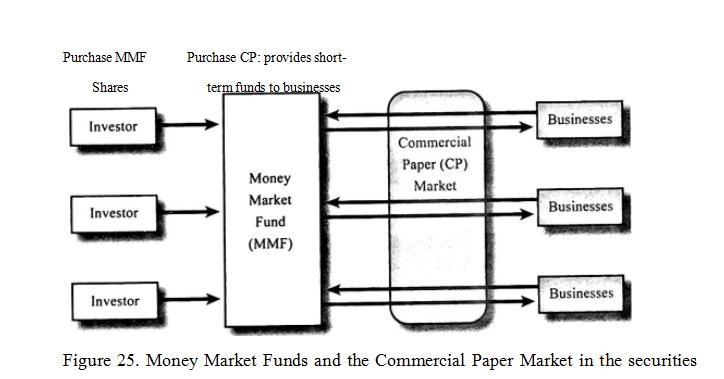
Figure 25. Money Market Funds and the Commercial Paper Market in the securities markets. It could not take deposits, not being a bank. Instead, it funded itself in short-term funding markets, including the commercial paper market. Lehman invested heavily in mortgage-related securities and also in commercial real estate during the 2000s. As house prices fell and delinquencies on mortgages rose, Lehman’s financial position got worse and it was also losing lots of money on its commercial real estate investments. So Lehman was becoming insolvent, it was losing money on all of its investments, and it was coming under a lot of pressure. And indeed, as Lehman’s creditors lost confidence, they started withdrawing funding from Lehman. For example, investors refused to roll over Lehman’s commercial paper and other business partners said, “well, we’re not going to do business with you anymore because we’re afraid you’re not going to be here next week.”So Lehman was losing money and increasingly unable to fund itself. It tried with the help of the Federal Reserve and the Treasury to find somebody willing either to put more capital into the firm or to acquire the firm. It was unable to do that, so on September 15th, as I mentioned, it filed for bankruptcy. This was an enormous shock that affected the whole global financial system.
One of the many effects of the failure of Lehman Brothers was on money market funds. One particular fairly large money market fund held, among its other assets, commercial paper issued by Lehman. When Lehman failed, that commercial paper became either worthless or at least completely illiquid for a long time. Suddenly, this money market fund could no longer pay off its depositors at a dollar per share. It didn’t, and it lost money. Now, suppose you are an investor in a money market fund and you know that if you ask for your dollar back, you can get it. But you also know that the fund does not have enough cash to pay everybody a dollar. What are you going to do? The same thing nineteenth-century bank depositors would do if they heard that their bank had lost money. So, investors in this fund and then in other money market funds began to pull out their money, just like a standard bank run. We had a very intense bank run or, in this case, a money market fund run, in which investors in these funds began to pull out their money just as quickly as they could.
The Fed and the Treasury responded very quickly to the situation. The Treasury provided a temporary guarantee that investors would get their money back if they did not pull it out right then. And the Fed created a backstop liquidity program, under which it lent money to banks, which in turn used that money to buy some of the assets of the money market funds. That gave the money market funds the liquidity they needed to pay off their depositors and helped to calm the panic.
To give you a sense of what was happening, figure 26 shows the daily money outflows from the money market funds. This is a two-trillion-dollar industry. You see the Lehman bankruptcy, and a couple of days later you see the money market fund breaking the buck, which meant that it was unable to pay its investors a dollar a share. Following that announcement, you can see that for two days, about one hundred billion dollars a day was flowing out of these funds. Within two days, the Treasury announced the guarantee program and the Fed came in to support the liquidity of these funds. And as you can see, the
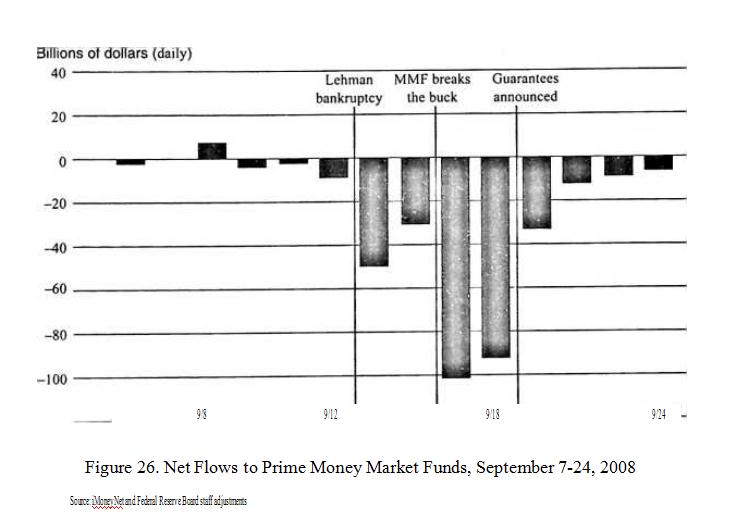
run ended pretty quickly. This was an absolutely classic bank run and a classic response: providing liquidity to help the institution being run provide cash to its investors, and providing guarantees. That successfully ended the run.
But that was not the end of the story, because the money market funds were also holding commercial paper. And as they began to face runs, they in turn began to dump commercial paper as quickly as they could. As a result, the commercial paper market went into shock. This is an excellent example of how financial crises can spread in all different directions. Lehman failed. That, in turn, caused the money market funds to experience a run, which led to a shock in the commercial paper market. So, everything is connected to everything else and it is really hard to keep the system stable. As the money market funds withdrew from the commercial paper market, there was a sharp increase in rates in the commercial paper market, and lenders were not willing to lend for more than maybe one day to commercial
paper borrowers, which in turn affected the ability of those companies to function and the ability of those financial institutions to fund themselves.
Once again, the Federal Reserve, responding in the way Bagehot would have had it respond, established special programs. Basically, it stood as a backstop lender; it said: “make your loans to these companies, and we will be here ready to backstop you if there is a problem rolling over these funds.”That restored confidence in the commercial paper market.
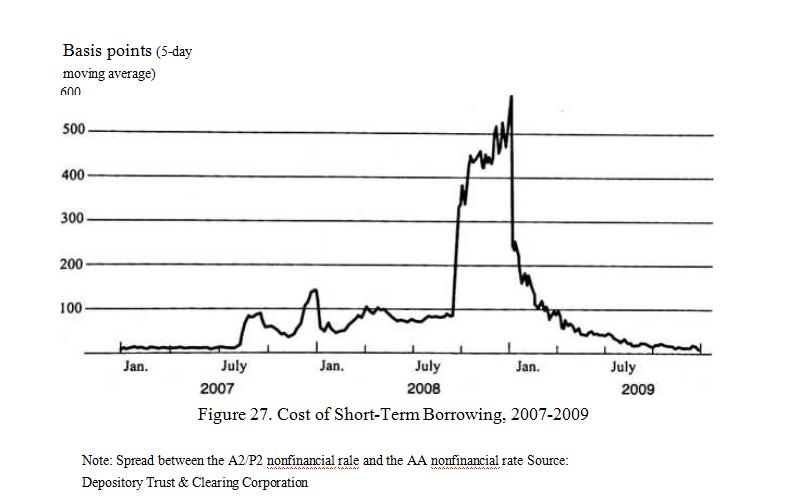
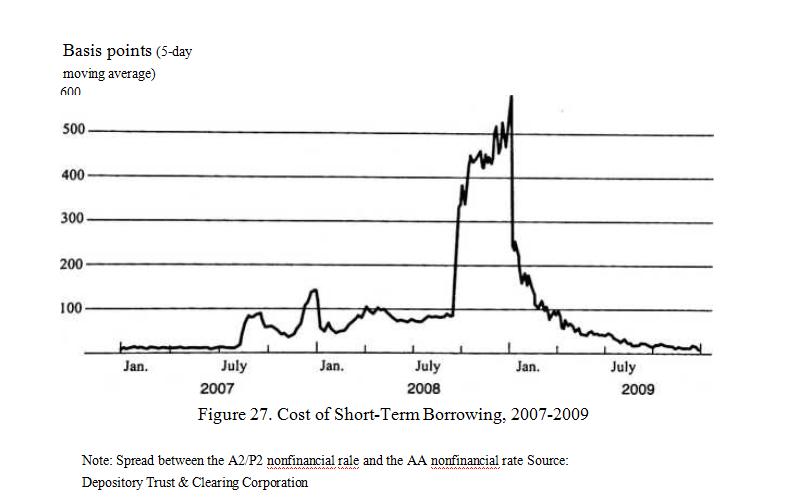
Figure 27 shows commercial paper rates. Once again, you can see the panic phenomenon, a sharp increase in rates, which really understates the pressure because it does not include the fact that for many companies, they could not get funding at any interest rate. Or if they got funding, it was only for overnight or very short-term periods. The Fed’s actions restored confidence in that market, and you can see the response: rates came back down at the beginning of 2009.
A lot of what I have been discussing you probably did not read too much about in the newspapers. I was working with these critical markets and providing broad-based liquidity to financial institutions to try to bring the panic under control. But the Fed and the Treasury also got involved in trying to address problems with some individual critical institutions.
In March 2008, as I mentioned, a Fed loan facilitated the takeover of Bear Steams by JPMorgan Chase, avoiding a failure of that firm. The reasons we undertook that action were, first, at the time the financial markets were quite stressed and we were fearful that the collapse of Bear Stearns would greatly add to that stress and perhaps set off a full-fledged financial panic; and second, we judged that Bear Steams was solvent. At least JPMorgan Chase thought so; it was willing to buy the firm and to guarantee its obligations. So by lending to Bear Steams, the Fed was acting consistent with the proposition that it should make loans that are likely to be paid back. The Fed felt that it was well secured in making that loan.
In the second example, AIG was very close to failure in October 2008. AIG, again, was the world’s largest insurance company. It was a complicated company. It was a multinational financial services company with many constituent parts, including a number of global insurance companies. But part of the company, called AIG Financial Products, was involved in all kinds of exotic derivatives and other types of financial activities, including, as I mentioned, the credit insurance that it was selling to the owners of mortgage-backed securities. So when the mortgage-backed securities started going bad, it became evident that AIG was in big trouble and its counterparties began demanding cash or refusing to fund AIG, and it came under tremendous pressure.
In our estimation, the failure of AIG would have been basically the end. It was interacting with so many different firms. It was so interconnected with both the U.S. and the European financial systems and global banks. We were quite concerned that if AIG
went bankrupt, we would not be able to control the crisis any further. Now, fortunately, from the perspective of lender of last resort theory, although AIG was taking a lot of losses in its financial products division, underlying those losses was the world’s largest insurance company. So AJG had lots and lots of perfectly good assets. Therefore, it had collateral that it could offer to the Fed to allow us to make a loan to provide the liquidity it needed to stay afloat.
And so, to prevent the collapse of AIG, we used AIG assets as collateral and loaned AIG eighty-five billion dollars. Later, the Treasury provided additional assistance to keep AIG afloat. That was highly controversial. The action was legitimate, we thought, first in terms of lender of last resort theory because it was a collateralized loan-and the Fed has in fact been fully paid back-and second, because AIG was a critical element in the global financial system. Over time AIG stabilized. It has repaid the Fed with interest. The Treasury still owns a majority of its stock, but AIG has been paying back the Treasury as well.
I would like to emphasize that what we had to do with Bear Stearns and AIG is obviously not a recipe for future crisis management. First, it was a very difficult and, in many ways, distasteful intervention that we had to do to prevent the system from collapsing. But clearly, there is something fundamentally wrong with a system in which some companies are “too big to fail.”If a company is so big that it knows that it is going to get bailed out, that is not at all fair to other companies. But even beyond that, “too big to fail”gives these big companies an incentive to take excessive risks, where they will say: “well, we’ll take big risks. Heads I win, tails you lose. If the risks pay off, we make plenty of money. And if they don’t pay off, the government will save us.?That is a situation that we cannot tolerate.
So, the problem we had in September 2008 was we really did not have any tool-legal tools or policy tools-that allowed us to let Bear Steams and AIG and the other firms go bankrupt in a way that would not cause incredible damage to the rest of the system. And therefore we chose the lesser of two evils and prevented AIG from failing. That being said, we want to be sure that this never happens again. We want to be sure that the system is changed so that if a large systemically critical firm like AIG comes under this kind of pressure in the future, there will be a safe way to let it fail, so that it can fail and the consequences of its mistakes can be borne by its management and shareholders and creditors without bringing down the whole financial system.
Finally, let me say a few words about the consequences of the crisis. We did stop the meltdown. We avoided what would have been, I think, a collapse of the global financial system. That was obviously a good thing. But one thing that I was always sure of and the Federal Reserve was always sure of was that a collapse of some of these big financial firms was going to have very serious collateral consequences. There were people arguing even as late as September 2008, “well, why don’t you just let the firms collapse? There is a system that can take care of it: bankruptcy. Why don’t you let them fail??We never thought that was a good option. Particularly, if the whole system had collapsed, we would have had extraordinarily serious consequences.
As it was, even though we prevented a total meltdown, there were still very serious collateral impacts not just on the U.S. economy but on the global economy as well. So following the crisis, even though the crisis was brought under control, the U.S. economy and much of the global economy went into a sharp recession. U.S. GDP fell by more than 5 percent, which is quite a deep recession. Eight and a half million people lost their jobs and unemployment rose to 10 percent.
And, as I said, this was not just a U.S. situation. The U.S. recession was, in fact, a rather average recession. Many countries around the world had worse declines, particularly those dependent on international trade. So it was a global slowdown. And as all this was happening, fears of another Great Depression were very real. Nevertheless, the Great Depression was much worse than the recent recession. And I think the view is increasingly gaining acceptance that without the forceful policy response that stabilized the financial system in 2008 and early 2009, we could have had a much worse outcome in the economy.
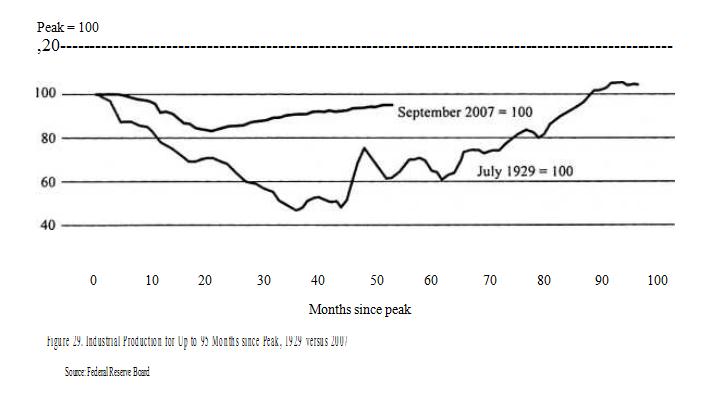
I will close with a couple of indicators to compare the recent recession with the Great Depression. First, figure 28 shows the stock market. The darker line starts in August 1929, which was the peak of the stock market before the Great Depression. The lighter line shows the more recent stock prices, starting in October 2007. And then each of the graphs shows you the evolution of stock prices in the Depression period and in the more recent period. What is striking is that for the first fifteen or sixteen months, stock prices in the United ' States behaved in this crisis very much as they did in 1929 and 1930. But about fifteen or sixteen months into the recent crisis, in early 2009, about the time that the financial crisis was stabilizing, look what happened. In the Depression era, stock prices kept falling and, as I mentioned, in the end stock prices lost 85 percent of their value. In the recent crisis,
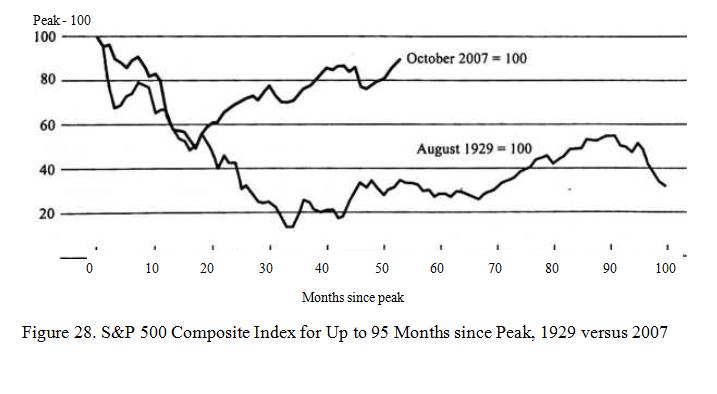
by contrast, U.S. stock prices recovered and began a long recovery, and they now are more than double where they were three years ago.
Figure 29 shows industrial production, a measure of output. Again, the lighter line graphs the more recent data. The darker line graphs the Depression-era data. You can see that in this recent crisis the fall in industrial production was not quite as severe or as fast as in the Depression. But you get the same basic phenomenon that about fifteen to sixteen months into the episode, about the time that the financial crisis was brought under control, industrial production bottomed out and began a period of steady recovery, whereas in the Depression, the collapse continued for several more years.
Dialogues
Student: In both this lecture and the previous one, you mentioned the increasing issuance of exotic and subprime mortgages. Why are financial institutions willing to bear so much risk to lend even to borrowers with poor credit? And if they had foreseen the decreasing prices in the housing market, would they still have made those loans?
Chairman Bernanke: There were a couple of reasons. One was simply the fact that firms were probably too confident about house price increases and said, ‘well, house prices are likely to keep rising.”And in a world in which house prices are rising, these are not such bad products because people can afford to pay for a year but then they can refinance to something more stable, and this may be a way to get people into housing. But the risk was that house prices would not keep rising, and of course that is ultimately what happened.
The second reason was that the demand for securitized products grew very substantially during this period. In part, there was a large international demand from Europe and from Asia for high-quality assets, and always-clever U.S. financial firms figured out that they could take a variety of different kinds of underlying assets, whether subprime mortgages or whatever, and through the miracle of financial engineering they could create from them at least some securities that would be rated triple-A, which they could then sell abroad to other investors. Unfortunately, that sometimes left them with the remaining bad pieces, which they kept or sold to some other financial firm.
So there were trends in the financial markets, including overconfidence about ability to manage those risks; a belief that house prices would probably keep rising; a sense that after they made those mortgages, they could sell them to somebody else and that other investor would be willing to acquire them; a big demand for “safe assets.”For all those reasons, it was actually a very profitable activity while it lasted. It was only when house prices began to fall that it became a big loser.
Student: You were talking about how one of the major things the Fed had to do was figure out how to get liquidity flowing again in the market. That reminds me of the Volcker Rule because, as I understand it, the Volcker Rule bans proprietary trading by investment banks, but it also left gray areas for principal trades, which, as I understand, are very important for market makers to create markets and find liquidity. So I wonder what you think about that. Doesn’t that seem rather counterintuitive?
Chairman Bernanke: Well, the Volcker Rule is a part of the Dodd-Frank financial regulatory reform, which the Fed and other agencies are tasked with implementing. The purpose of the Volcker Rule, as you said, is to reduce the risk of financial institutions by preventing banks and their affiliates from doing proprietary trading, which means doing short-term trading on their own accounts. The Dodd-Frank law recognizes that there are legitimate reasons that banks might want to acquire short-term securities and it makes certain exceptions for them. They include, for example, hedging against risk. But one particular exception is to make markets, to serve as intermediaries who buy and sell in order to create liquidity in a particular market-that is exempted from the Volcker Rule. One of the challenges of implementing this rule is trying to figure out how to create a set of standards that allows the so-called exempted or legitimate activities,
such as market making and hedging, while ruling out proprietary trading. That is very difficult, and we are working on that. We put out a rule and we have gotten thousands of comments, which we are looking at to figure out how best to do that.
But the point you raised is that liquidity in markets is important. During the crisis, it was a much worse problem than just a lack of trading volume. You had big financial institutions unable to find the funding to support their asset positions, which left them with two possibilities: either defaulting because they do not have enough funding, or (the tack that many of them took) selling off assets as quickly as possible, which in turn spreads panic. Because if there is a huge seller’s market for, say, commercial real estate bonds, that is going to drive the price down very sharply. And then any company that is holding those bonds finds its financial position being eroded and that creates pressure on it.
I did not use the word contagion in my discussion. A contagion, just as in an illness context, is the spreading of panic, the spreading of fear from one market or institution to another. Contagion has been a major problem in many financial panics, and certainly in this one. That was one of the mechanisms that caused funding pressures to jump from firm to firm and created such a broad-based problem.
Student: I have a question about global collaboration during the financial crisis. You talked about the G7 in 2008. Specifically, as we saw multinational corporations begin to be on the brink of failure, what pressures came from the international community when the decision to, say, bail out AIG was being debated?
Chairman Bernanke: Well, there weren’t any real pressures. Everything was happening too fast. I think one area where collaboration was not as good as we would like was in dealing with some of these multinational firms. For example, there were problems between the United Kingdom and the United States over the failure of Lehman Brothers, and inconsistencies that caused problems for some of Lehman’s creditors.
So one of the things we are trying to do under the Dodd-Frank financial reform legislation, as I mentioned before, is to create provisions for safely allowing large financial firms to fail. But one of the complexities is that many of the firms that this would be applied to are multinational firms, operating not just in two or three countries but maybe in dozens of countries. And so, we are collaborating with other countries in figuring out how we would work together to help a large multinational firm fail as safely as possible. We tried during the crisis to cooperate in mostly ad hoc ways, and we were in touch with regulators in the United Kingdom and elsewhere. But, given the time frame and the lack of preparation, we did not do as much as we would have been able to do with more lead time. So 1 think that was a weakness of international collaboration.
For the most part, though, countries cooperated in dealing with the financial institutions that were based in their own countries. AIG was an American company, and we dealt with that, whereas Dexia, which was a European company, was dealt with by the Europeans. Also, there was a lot of cooperation between central banks. A lot of European banks needed dollar funding as opposed to euro funding. They use dollar funding because they hold dollar assets and they make loans to support trade, which is often done in dollars, so they needed dollars.The European Centra! Bank cannot provide dollars. So we did what was called a swap, where we gave the European Central Bank dollars and they gave us euros. They took the dollars we gave them and lent them on their own recognizance to European banks, easing dollar funding pressures around the world. So, those swaps, which are still in existence because of the recent issues in Europe, were an important example of collaboration. Also, in October 2008, right as this crisis was intensifying, the Federal Reserve and five other central banks all announced interest rate cuts on the same day. So we coordinated even our monetary policy. There were some areas, such as multinational firms, where a lot more preparation was needed and we are still working on those things cooperatively today.
Student: Could you elaborate on the off-balance-sheet vehicles that were being used and why banks were allowed to keep that much information off their books?
Chairman Bernanke: It has to do with accounting rules, basically. You create this separate vehicle, and the bank might have substantial interest in that vehicle. It might, for example, have a partial ownership. It might have some promises to provide credit support if it goes bad or liquidity support if it needs cash. But under the rules that existed at that time, if the amount of control that the bank had on this off-balance-sheet vehicle was sufficiently limited, then according to the accounting rules, the bank could treat it as a separate organization, not part of the bank抯 own balance sheet. That allowed the banks to get away with holding somewhat less capital reserves, for example, than they would have had to carry if all these assets were on their own balance sheets.
One of the many good developments since the crisis is that these rules have been reworked, and many of the off-balancesheet vehicles that existed before the crisis would no longer be allowed. They would have to be consolidated, which means they would have to be made part of the bank’s balance sheet, have appropriate capital reserves, and so on. So those practices are not completely gone, but the accounting rules have greatly tightened the situations and circumstances under which a bank can put something off its balance sheet into a separate investment vehicle.
Student: You mentioned several large firms that came under pressure in 2008 and also the Fed抯 doctrine, if you will, of “too big to fail.”Where do you draw the line between bailing out a bank and allowing it to fail? Is it arbitrary or is there some sort of methodology that the Fed goes by?
Chairman Bernanke: This is a great question. First, I want to resist the word doctrine. These firms proved to be too big to fail in the context of a global financial crisis. That was a judgment we made at the time based on their size, their complexity, their interconnectedness, and so on. It was not something that we ever thought was a good thing. Again, one of the main goals of the financial reform is to get rid of “too big to fail” because it is bad for the system. It is bad for the firms. It is unfair in many ways, and it would be a great accomplishment to get rid of “too big to fail.”So it was not something that we advocated or supported in any way. We were just in a situation where we were forced to choose the least bad of a number of different options.
During the crisis, we had to make judgments on a case-bycase basis, and we were trying to be as conservative as possible. In the case of A1G, there was really not much doubt in our minds. This was a case where action was necessary, if at all possible. Lehman Brothers was itself probably “too big to fail,”in the sense that its failure had enormous negative impacts on the global financial system.
But there we were helpless because it was essentially an insolvent firm. It did not have enough collateral to borrow from the Fed. We cannot put capital into a firm that is insolvent. This was before the Troubled Asset Relief Program (TARP), which provided capital that the Treasury could use. So we had no legal way to save Lehman Brothers. I think if we could have avoided letting it fail, we would have done so. In the two cases where we intervened, Bear Stearns and AIG, the judgment was pretty clear, given not only the firms themselves but also the environment at the time.
Now interestingly, we have had to get much more into this issue since the crisis because there are a number of different rules and regulations that actually require the Fed and other regulatory agencies to make some determination about how systemically critical a firm is. For example, the new Basel 3 capital requirements require the largest, most systemically critical firms to have a capital surcharge. They have to hold more capital than firms that are not as systemically critical.
As part of that process, the international bank regulators have worked together to set up criteria relating to size, complexity, interconnectedness, derivatives, and a whole bunch of other criteria that help determine how much extra capital these
large firms have to hold. Likewise, the Fed, when it considers a proposed merger of two banks, now has to evaluate whether the merger would create a systemically more dangerous situation. So we have worked hard, and we have put out a variety of criteria including some numerical thresholds that we look at to try to figure out if a merger creates a systemically critical firm, and if it does, we are not supposed to allow that merger to happen.
So, the science of doing this is progressing. It is still in its infancy. But we are looking very seriously at this and, indeed, now that the Fed has become much more focused on financial stability, we have a whole division of people working on various metrics and indicators to try to identify risks to the system and firms that need to be particularly carefully supervised and maybe required to hold extra capital because of the potential risk they pose to the system.
Student: One vulnerability that you mentioned was that the credit-rating agencies were assigning triple-A ratings to securities that carried much more risk than perhaps a triple-A rating might warrant. It seems as though the incentives would be aligned for the buyers to seek out ratings that were more accurate because they would be taking on more risk. Was there a systemic problem as far as how incentives were aligned within the credit-ratings system that allowed these faulty ratings to propagate throughout the system?
Chairman Bernanke: Yes, there were some incentive problems, and you identify one of them, which is that, instead of the seller of the security being the one who hires and pays the credit rater, you would think that it would be in the interest of the buyers, who after all are the ones bearing the risk, to band together and pay the credit rater to give them the best opinion they can about what the credit quality is of the security.
Unfortunately, that model does not seem to work. The problem is what economists call a free-rider problem. Basically, if five investors get together and pay Standard and Poor’s to rate a particular issuance, unless they can keep that completely secret, anybody else can find out what the rating was and take advantage of that without being part of the consortium that paid.
So there have been a lot of ideas out there about how you can restructure the payment system to create better incentives for credit raters. But it is a challenging problem because, again, the “obvious solution”of having the investors pay only works if the investors collectively can share the cost and somehow keep that information from being spread among other investors.