Lecture 2 The Federal Reserve after World War II
It is very helpful to put the recent crisis and the ongoing recovery into historical context. As we go along, 1 want to make sure you keep your eyes on the ball, that is, the two basic missions of a central bank. The first is maintaining macroeconomic stability: maintaining stable growth and keeping inflation low and stable. The principal policy tool for maintaining macroeconomic stability is monetary policy. In normal times, the Fed and other central banks use open market operations—purchases and sales of securities in markets—to move interest rates up or down, and in doing so try to create a more stable macroeconomic environment.
The second part of a central bank’s mission is maintaining financial stability. Central banks are focused on trying to ensure that the financial system functions properly, and in particular, they want to prevent, if possible, and if not, to mitigate the effects of a financial crisis or a financial panic. 1 talked last time about the lender of last resort function, the notion that in a financial panic, a central bank should follow Bagehot’s rule of lending freely against good collateral at a penalty rate, and by providing short-term credit to financial institutions, a central bank can halt or reduce a run or a panic and the accompanying damage to the financial system and the economy.
But let’s talk a little bit about history. We left off at World War II, which ended the Depression and led to a sharp drop in unemployment as people were put to work building munitions and serving on the home front. One of the aspects of wars that economists pay attention to is how they get financed. Normally, wars are financed very substantially by borrowing. During World War II, the U.S. national debt increased quite substantially to pay for the war. And the Fed, in cooperation with the Treasury, used its ability to manage interest rates to keep interest rates low, so as to make it cheaper for the government to finance World War II. So that was the role of the Fed during the war.
After the war ended, the debt was still there. The government was still worried about paying the interest on the national debt, which was at a very high level, and so there was considerable pressure on the Fed to keep interest rates low even after the war. But that had the drawback that, if one keeps interest rates low even as an economy is growing and recovering, one risks overheating the economy and triggering inflation. By 1951, the Fed was very concerned about inflation prospects in the United States. After a series of complex negotiations, the Treasury agreed to let the Fed set interest rates independently, as needed, to achieve economic stability. That agreement, called the Fed-Treasury Accord of 1951, was very important because it was the first clear acknowledgment by the government that the Federal Reserve should be allowed to operate independently. Today, around the world there is a very strong consensus that central banks that operate independently will deliver better results than those that are dominated by the government. In particular, a central bank that is independent can ignore short-term political pressures, for example, to pump up the economy before an election, and in doing so, it can take a much longer perspective and get better results. The evidence for this is quite strong. As a result, major central banks around the world are typically independent, which means that they make their decisions irrespective of short-term political pressures.
In the 1950s and the 1960s, the Fed’s primary concern was macroeconomic stability. Monetary policy during that period was relatively simple because the economy was growing. As after World War 1, the U.S. economy was dominant after World War II. The fears about a renewed Depression had not come true. As a result, a lot of growth was occurring. The Fed tried to follow what is called a “lean against the wind” monetary policy, which means that when the economy is growing quickly (or too quickly), the Fed tightens to try to restrain overheating, and when the economy is growing more slowly, the Fed lowers interest rates and creates some expansionary stimulus in order to avoid a recession. William McChesney Martin, who was chairman of the Federal Reserve from 1951 to 1970, was very attentive to the risks of inflation. He said, “Inflation is a thief in the night.” He tried through this “lean against the wind” policy to keep inflation and growth stable. The 1950s were perhaps more tumultuous than you might think, with a serious war in Korea and a couple of recessions during that decade. Nevertheless, it was basically a productive and prosperous decade as the economy went back to civilian operations after the end of World War II.
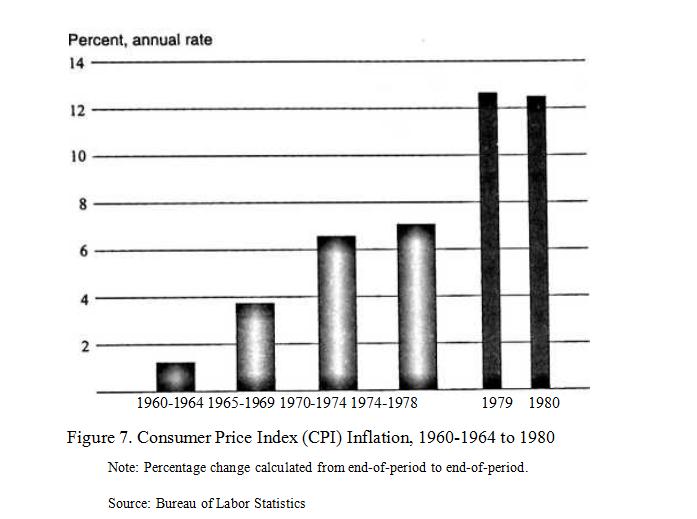
Things were not to remain completely trouble-free, however. Starting in the mid-1960s, for a variety of reasons that I will discuss, monetary policy became too easy. And after a time when the Fed did not change its policy stance, this easy monetary policy led to a surge in inflation and inflation expectations. Figure 7 shows a graph of inflation. You can see that from 1960 to 1964, inflation averaged only a little over 1 percent per year. It picked up during the Vietnam War period, 1965 to 1969, and went even higher in the early 1970s. By the end of the 1970s, the consumer price index (CPI) inflation rate peaked at about 13 percent. Inflation was a growing problem starting in the mid-1960s and into the 1970s.
Why was monetary policy so easy as to allow inflation to become a problem in the
1970s One issue was technical: monetary policy makers became too optimistic about how hot the economy could run without generating inflation pressures. It was a general view that unemployment could be kept at a low level, 3 or 4 percent. By keeping inflation a little bit higher, you would be able to get that higher employment level. In the prosperity of the 1950s and the early 1960s, the Fed began to follow that approach. There was actually quite a subtle issue here, which was that economic theory and practice in the 1950s and early 1960s suggested that there was a permanent trade-off between inflation and employment, the notion being that if we could just keep inflation a little bit above normal, we could get permanent increases in employment and permanent reductions in unemployment. That view was taken by many economists during that time.
Milton Friedman, the famous monetary economist, wrote in the mid-1960s quite prophetically that this was going to cause trouble. He argued that an increase in inflation might cause unemployment to fall for a while but at best it would be a transitory effect. The analogy might be to a candy bar: if you eat a candy bar, in the short run it gives you a burst of energy, but after a while, it just makes you fat. Friedman argued, and he turned out to be quite prescient, that attempts to keep unemployment too low through monetary policy were going to end up creating inflation.
Today, it is still debated whether political pressures were put on the Fed to keep monetary policy too easy during that period. After all, this was another period of government deficits, as the government was trying to finance the Vietnam War and the Great Society. That may have influenced the Fed’s behavior as well.
You cannot have sustained inflation without monetary policy being too easy. In another famous quote Milton Friedman said, “Inflation is always and everywhere a monetary phenomenon.” Nevertheless, a bunch of exacerbating factors made the problem worse and made it more difficult for the Fed to offset the increase in inflation. First, there were a number of shocks to the prices of oil and food. A very striking example occurred in 1973. In October 1973, the Yom Kippur War in the Middle East broke out. In retaliation against U.S. support of Israel, OPEC (Organization of the Petroleum Exporting Countries) used its cartel power to embargo oil exports. Over a short period in the early 1970s, the price of oil almost quadrupled, causing a very sharp increase in gas prices. People were lining up at gas stations to fill their gas tanks. There was a system of even-odd rationing. If your license plate had an even number, you could go to the gas station only on Tuesdays and Thursdays.
If it had an odd number, you could go only on Mondays and Wednesdays. It was a very serious issue and there was a lot of unhappiness about gas prices then (as there is today).
Fiscal policy overall was too loose during the late 1960s and early 1970s. The Vietnam War and other government programs increased government spending and increased deficits, which put additional pressure on the capacity of the economy.
Another element that I will mention briefly is wage-price controls. When inflation got up to about 5 percent in the early 1970s, President Richard Nixon introduced wage- price controls, a series of laws that forbade firms from raising their prices. There were exceptions, and there were all kind of boards to try to find exceptions. It was basically a very unsuccessful policy. As you know, prices are the thermostat of an economy. They are the mechanism by which an economy functions. So, putting controls on wages and prices meant that there were shortages and all kinds of other problems throughout the economy. But in addition, as Milton Friedman put it, this was like dealing with an overheating furnace by breaking the thermostat. The fundamental problem was the fact that there was too much aggregate demand driving up prices, and simply passing a law that forbade raising prices did not address the underlying problem of excessive monetary ease and excessive demand. So, wage-price controls kept inflation artificially low for a couple of years, which made it harder for the Fed to figure out what was going on. When the wage-price controls finally collapsed in disarray, because they were creating so many proximity problems in the economy, inflation surged, like a spring that was released. So there were a lot of causes for the increase in inflation.
Arthur Bums, who was the chairman of the Fed during the 1970s, said, “In a rapidly changing world, the opportunities for making mistakes are legion,”which is certainly true. One way to think about this whole episode is that after World War II and the end of the Depression, and with the prosperity they saw, economists and policymakers became a little bit too confident about their ability to keep the economy on an even keel. They used the term fine tuning to refer to the notion that the Fed and fiscal policy and other government policies could keep the economy more or less perfectly on course and not worry about bumps and wiggles in the economy. That turned out to be too optimistic, too hubristic, as we collectively learned during the 1970s when the efforts of policymakers resulted, not in a lower unemployment rate, which was the original goal, but instead in a very sharp increase in inflation. So one of the themes here is that--and this probably applies in any complex endeavor--a little humility never hurts.
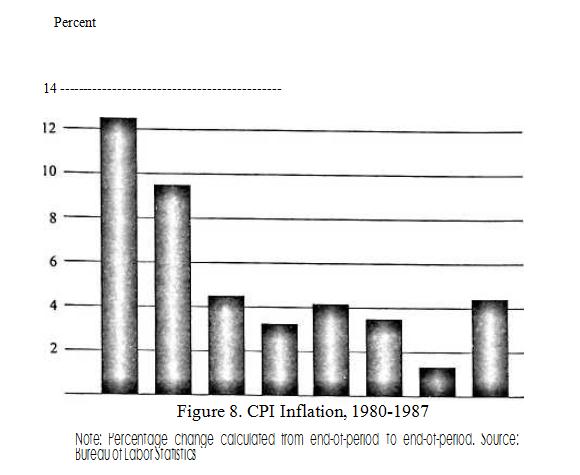
There was a reaction to the increase in inflation in the 1970s, and the key person in this period is Chairman Paul Volcker, who remains to this day an influential figure in economic policy discussions. President Jimmy Carter, whose reelection was seriously threatened by the poor performance of the U.S. economy, appointed Volcker to be the new chairman of the Fed. He did so partly because he thought that Volcker was a tough central banker who would do what was necessary to get inflation under control. And Volcker, who stands six feet eight and smokes a big cigar, certainly gave the impression of somebody who was willing to take strong action. Volcker had been in office for only a few months when he determined that strong action was needed to address the inflation problem. In October 1979, he and the Federal Open Market Committee (FOMC), the policy making committee of the Fed, instituted a strong break in the way monetary policy was managed. Basically, it allowed the Fed to raise interest rates quite sharply. Raising interest rates slows the economy and brings inflation pressures down. As Volcker said, “To break the inflation cycle, we must have credible and disciplined monetary policy.”And it worked. In the years after this program began, inflation fell quite sharply. In figure 8, you can see that from 1980 to 1983, inflation fell from about 12 or 13 percent all the way down to about 3 percent--a relatively quick decline in inflation that offset the problems of the late 1970s. In that respect, the policies of the 1980s were quite successful: they achieved their objective of bringing inflation under control. Nothing is free, however, and one of the effects of these policies was to raise interest rates quite sharply for consumers and businesses. I had just gotten out of graduate school, and I remember in about 1981 or 1982 looking at the possibility of buying a home and being informed that the rate for a thirty-year mortgage was 18.5 percent.
So interest rates were quite high and, as one might expect, that brought down economic
activity and effective inflation as well.
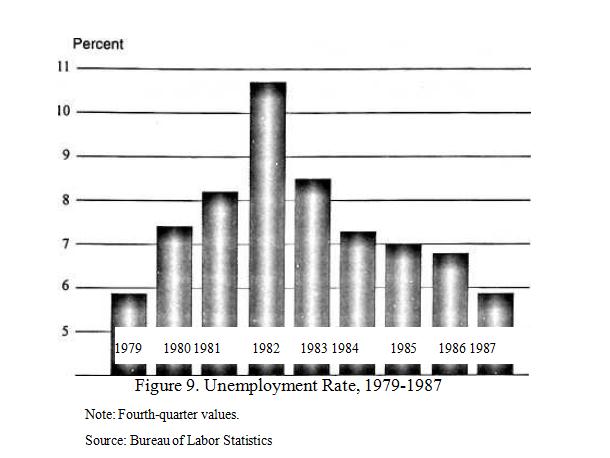
In figure 9, you see the unemployment rate during this period. The high interest rates, which were necessary to bring down inflation, also caused a very sharp recession. The unemployment rate in 1982 was almost 11 percent, even higher than we saw in the most recent recession. So, there were definitely very negative side effects from Volcker’s actions.
As you can imagine, the political pressure on the Fed and on Chairman Volcker was intense. During this period, it was common practice to mail to the Fed bits of two-by-fours. And on the two-by-fours it would say, “stop killing construction,”or “save the farmer,”or whatever, because the high interest rates were having very negative effects on the economy. I keep a few of these on my desk to remind me that inflation is a concern and that we always have to pay attention to price stability. But this is also an example of why independence is important. If Volcker had needed to be reelected, perhaps he would not have been able to
sustain his policy. Instead, he maintained an independent monetary policy. He received at least sufficient support from President Ronald Reagan and from the Congress to be able to carry through the policy, which succeeded in bringing inflation down.
During the 1970s, output and inflation were very volatile. We saw how much inflation moved around. There was a pretty sharp recession in 1973-1975 after the OPEC embargo. And then there was more volatility in the early 1980s as Volcker brought down inflation and the economy went into recession.
Volcker left the chairmanship in 1987, and he was succeeded by Alan Greenspan, who held that position for almost nineteen years, from 1987 to 2006. One of Greenspan's important accomplishments for most of his tenure was achieving greater economic stability. As he said, “an environment of greater economic stability has been key to the impressive growth in the standards of living...in the United States.”There was so much improvement in stability of the economy that the period has come to be known as the Great Moderation, as opposed to the Great Stagflation of the 1970s or the Great Depression of the 1930s. The Great Moderation was a very real and striking phenomenon. Figure 10 shows the variability of real GDP growth from 1950 essentially to the present. The line shows quarterly growth rates in GDP. So a sharp peak shows an increase in GDP growth and a drop shows a decline in GDP growth. These are quarterly numbers. You can see the bounciness--periods of rapid growth followed by periods of slower growth. The shaded area in the left-hand portion of the graph is a one standard deviation band. Essentially, it is a measure of the average volatility of GDP growth quarter to quarter during the period between 1950 and 1985. You can see that GDP growth was pretty variable throughout the entire period. There was a lot of volatility in the economy. There were a number of recessions, including the severe ones in 1973 and 1981. Now, look at what happens to GDP variability between 1986 and 2007
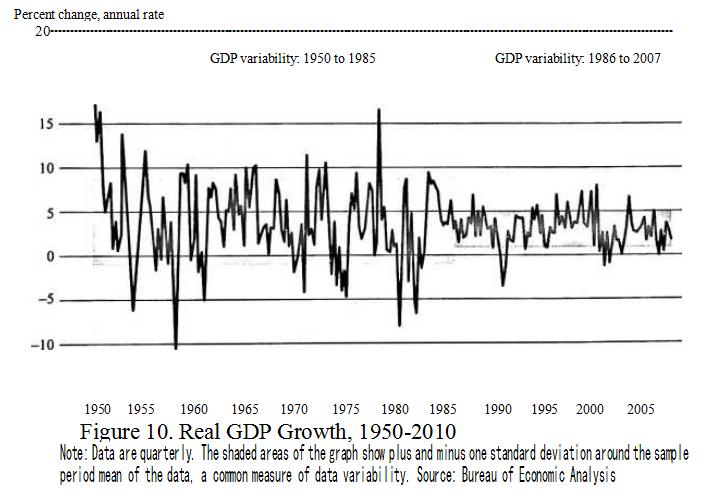
or so. The variability from quarter to quarter is much less, and the shaded band to the right shows the average variability of one standard deviation for GDP growth in this latter period. It is very striking how much more stable the economy was over this roughly twenty-year period.
This was true not only for real GDP growth; it was also true for inflation. Figure 11 shows basically the same picture. The vertical line in the middle of the graph splits the time period into pre-1986 and post-1986. The graph shows inflation quarter by quarter as measured by the CPI. Again, the shaded bar on the left side of the graph shows one standard deviation average volatility of inflation in the pre-1986 period. You can see the huge spikes in inflation in the 1970s. And then in post-1986, you see much lower volatility. So both growth and inflation were more stable to a quite remarkable extent, which economists commented on quite frequently. That was the so-called Great Moderation.
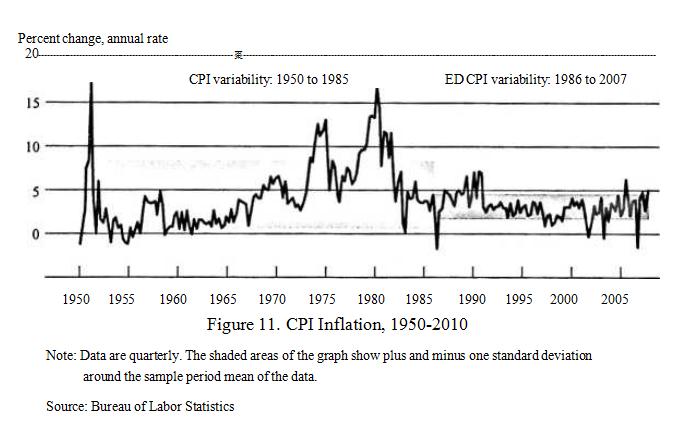
Why was the economy so much more stable between the mid-1980s and the mid- 2000s? Lots of research has been done on this question. There is quite a bit of evidence that monetary policy played a role in creating better stability. In particular, even though Volcker?s efforts to bring down inflation in the early 1980s led to a deep recession and a lot of pain in the short term, there was a payoff. That payoff was an economy that was much more stable, with low, stable inflation, more stable monetary policy, and more confidence on the part of business people and households-and that contributed very significantly to broader stability. Remember that Friedman pointed out that there was no long-term tradeoff between inflation and unemployment: one could not permanently lower unemployment by keeping inflation a little higher. That is true. But in a different sense, low and stable inflation over a long period makes an economy more stable and supports healthy growth and productivity and economic activity. So low inflation is a very good thing, and the reduction in inflation that occurred in the 1980s was really a global phenomenon. A lot of countries had inflation problems in the 1980s, but all around the world, even developing countries brought down their inflation rates quite considerably, and that has been a positive for economic growth and stability since the mid-1980s.
Not all of the Great Moderation was caused by monetary policy. Other factors no doubt played a role. One is general structural change in the economy. An example would be that, over time, firms have learned how to manage their inventories much more effectively. The practice of so-called just-in-time inventory management is a practice in which, instead of having large stocks of inventory on hand, firms acquire inputs only when they need them for production. Not having large stocks of inventory on hand reduces an important source of fluctuations in the economy because, if demand slows down and you have a big inventory, then you do not do any more production for quite a while until you run down that inventory. Improved management of inventories is just an example (I could cite many others) of better business practices and other factors in the economy that made things more stable. And it may also be the case that there was just better luck-we had fewer oil price shocks and other things happening-and that too may have contributed to the Great Moderation. But as figures 10 and II showed, there was quite a striking change in the way the economy operated after the mid-1980s.
Another aspect of the Great Moderation is that there were not any big, damaging financial crises in the United States. There was a stock market crash in 1987, but it did not do much damage. A more significant event was the boom and bust in the dot-com stocks in the late 1990s, and that touched off a mild recession in 2001. But one of the inferences people took away from the Great Moderation was not only was the economy more stable but the financial system seemed more stable as well. As a result, financial stability policies got deemphasized to some extent during this period.
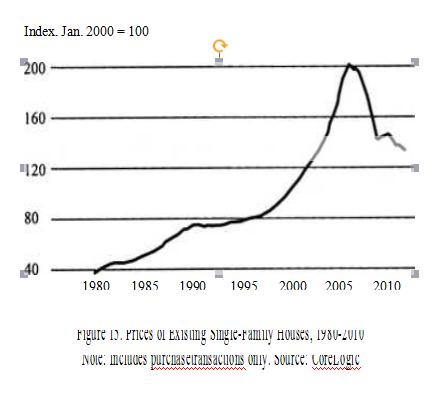
Let’s turn now to the prelude to the financial crisis. One of the key events that led ultimately to the recent crisis was a big increase in house prices. Figure 12 shows prices of existing single-family homes, where January 2000 is indexed to be 100. From the late 1990s until early 2006, house prices across the country increased by about 130 percent. You can see that line going straight up, a very sharp increase in home prices. And as I will discuss,
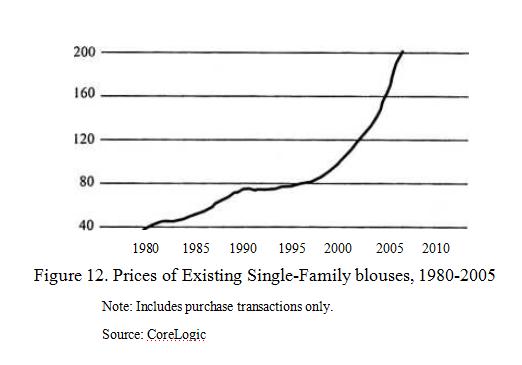
at the same time that was happening or perhaps a little bit later in the process, the lending standards for new mortgages to buy homes were deteriorating. Now clearly, a big part of what was happening to create the housing bubble or the increase in housing prices was psychology. After all, the late 1990s was a period with a lot of optimism about tech stocks and the stock market more generally. And some of that optimism, no doubt, spilled over into the housing market. So there was an increasing sense that house prices would keep rising and that housing was a “can’t lose”investment. I lived in California for a while, earlier than this but during a period when house prices were rising, and all everybody talked about at cocktail parties was, “what’s your house worth now?”and “how much money are you making on your home?”It made working seem rather unnecessary because all you had to do was keep checking the real estate listings. So there was a lot of excitement and enthusiasm about the fact that house prices were going up and making everybody rich. At the same time that this was happening, the standards for underwriting new mortgages were getting worse and worse, which in turn was bringing more and more people into the housing market and pushing up prices even further.
Let’s talk a bit about mortgage quality. Prior to the early 2000s, home buyers were typically asked to make a significant down payment of 10 percent, 15 percent, maybe 20 percent of the home price. And they had to document their finances (their income, their assets, and so on) in great detail to persuade the bank to make them a loan, which in many cases might be four or five times their annual salary. Unfortunately, as house prices rose, many lenders began to offer mortgages to less-qualified borrowers, so-called nonprime mortgages.?These mortgages often required little or no down payment and little or no documentation. Essentially, mortgage lenders were moving further down the credit spectrum, lending to more and more people whose credit was less than stellar. You can see this in a number of different ways. Figure 13a shows the percentage of mortgage originations -- that is, new mortgages created--that were nonprime (subprime or Alt-A or
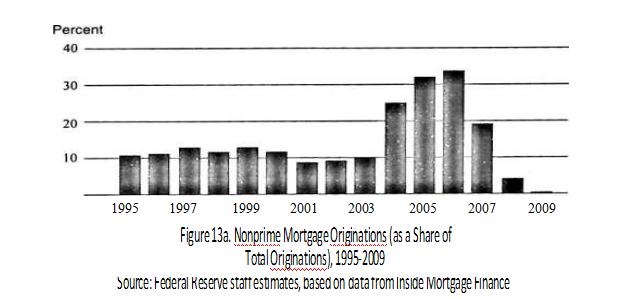
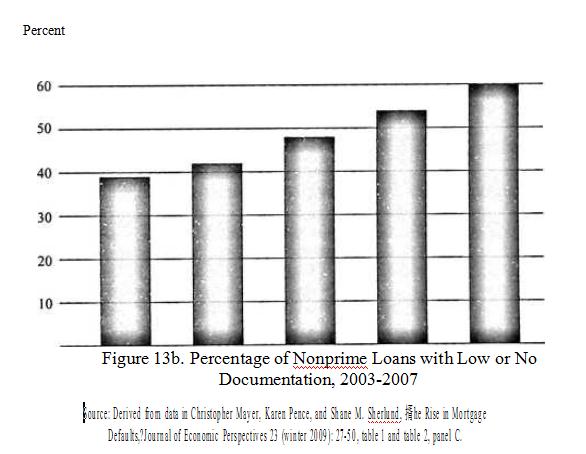
some other lower-quality mortgage). You can see the very sharp increase, particularly in the middle of the 2000s and 2006. Almost one-third of all mortgages that were originated were nonprime. Figure 13b shows another indicator of the deterioration of mortgage quality: the percentage of nonprime loans with low or no documentation. If you think about it, this is rather perverse. If you are going to make a loan to somebody whose credit is shaky, who does not have a down payment, whose FICO score is low, and so on, one would think you would want to ask them even more questions about their income and their prospects. But, in fact, it went the other way. And as you can see, by 2007, 60 percent of nonprime loans had little or no documentation of the creditworthiness of the borrower. So there was clearly an ongoing deterioration of mortgage quality.
This situation could not go on forever. Figure 14 shows the debt-service ratio. As house prices went up and up and up, the share of borrowers?incomes being spent on their monthly mortgage payments went up. As you can see, eventually mortgage payments became quite a large share of personal disposable income, finally reaching the point that the cost of homeownership was high enough that it began finally to dampen the demand for new
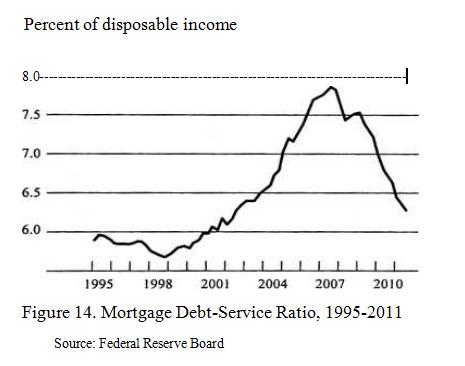
houses. The debt-service ratio collapsed after that, basically because interest rates came down. But the main point here is that high payments on mortgages finally meant that there were no longer new home purchasers, and so the bubble burst and house prices fell. Figure 15 shows home prices. You can see the sharp increase from the late 1990s up until about 2006. But from 2006 until today, house prices have fallen more than 30 percent. So there has been a very sharp decline in home prices across the country.
One comment about figure 15: if you look at this graph you might say to yourself, “oh my gosh, we have a long way to go,”because house prices today are still significantly above where they were fifteen years ago. But remember, these prices are in dollar or nominal terms; there is no adjustment for inflation. So even if there was just 2 percent inflation per year, over a period of fifteen years that would raise prices by 30 or 40 percent. So if you adjust for inflation, you find that house prices now are coming much closer to where they were before the beginning of the bubble.
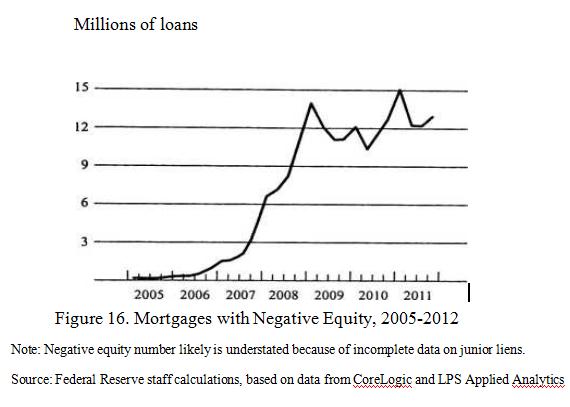
The house price collapse had some significant consequences. One consequence is that many people who had felt rich because their home values had gone up and they had a lot of
equity suddenly found themselves underwater, which means that the amount of money they owed on their mortgages was greater than the value of their homes. This is an upside-down situation where the borrower in fact has negative equity in the home. In figure 16, you can see that starting in 2007, the number of mortgages that were in negative equity grew very sharply. Currently, about twelve or thirteen million mortgages out of a total of about fifty-five million or
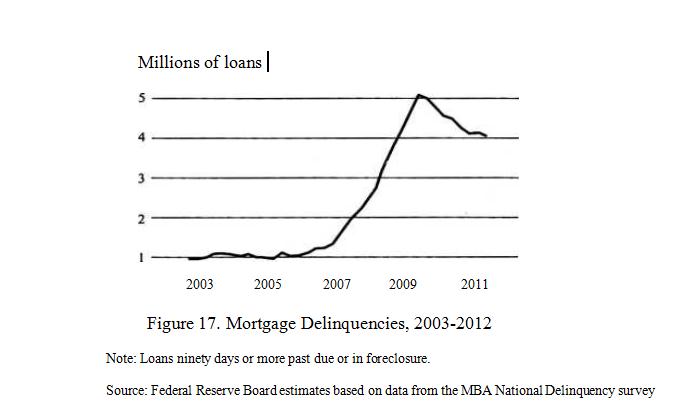
At the same time, given the fact that a lot of people borrowed more than they could afford, the decline in house prices also led to a big increase in mortgage delinquencies, people not paying on time, and ultimately the bank taking over the property-that is called a foreclosure-and then reselling the property to somebody else. Mortgage delinquencies are graphed in figure 17, and you can see that in 2009, there were more than five million mortgages in delinquency, which is almost 10 percent of all mortgages. That is a very, very high rate of
We just looked at the effects of the house price bust on borrowers and homeowners, and those are quite serious. But there is another side to this, which is the effect on lenders. With approximately 10 percent of mortgages in delinquency, banks and other holders of mortgage-related securities suffered sizable losses and that proved to be an important trigger of the crisis. There is an interesting question here. In 1999, 2000, and 2001, we had a big increase in stock prices, including, but not confined to, dot-com or tech bubble prices. Those prices fell very sharply in 2000 and 2001, and a lot of paper wealth was destroyed. In fact, the amount of paper wealth destroyed by the decline in dot-com and other stock prices was not radically different from the amount of wealth destroyed by the bursting of the housing bubble. And yet, the dot-com bust led only to a mild recession. The 2001 recession lasted from March to November 2001; it was only an eight-month recession. Unemployment rose, but not nearly so dramatically as in the 1980s or more recently. And so, here we had a big boom and bust in stock prices, but without causing too much serious or lasting damage to the financial system or the economy. In the recent case, we had a housing boom and bust. If we were looking back at 2001, we would think that would cause a slowdown in the economy, but probably it would not be very serious. That was one of the views we were discussing in the Fed in 2006, as we saw house prices decline. Yet, the decline of house prices had a much bigger impact on the financial system and the economy than the decline of stock prices did. To understand that, it is important to make a distinction between triggers and vulnerabilities. The decline in house prices and the mortgage losses were a trigger. They were a match thrown on kindling. There would not have been a conflagration if there had not been a lot of dry tinder around. In this case, there were vulnerabilities in the economy and in the financial system that the housing bust in some sense set afire. In other words, there were weaknesses in the financial system that transformed what might otherwise have been a modest recession into a much more severe crisis.
What were those vulnerabilities? What was it about the financial system of the United States and of other countries as well that transformed the housing boom and bust into a much more serious crisis? There were vulnerabilities both in the private sector of our financial system and also in the public sector. In the private sector, many borrowers and lenders took on too much debt, too much leverage. And one reason they did that may have been the Great Moderation. With twenty years of relatively calm economic and financial conditions, people became more confident, willing to take on more debt. The problem with taking on too much debt is that if you do not have much margin, if the value of your asset goes down, then pretty soon you will find that you have an asset that is worth less than the amount of money you borrowed.
A second, very important problem was that during this period, financial transactions were becoming more and more complex but the ability of banks and other financial institutions to monitor and measure and manage those risks was not keeping up. That is, their IT systems and the resources they devoted to risk management were insufficient for them to understand fully what risks they were actually taking and how big the risks were. So if in 2006 you asked a bank about the effect if house prices fell 20 percent, it probably would have greatly underestimated the impact on its balance sheet because it did not have the capacity to measure accurately or completely the risks that it was facing.
A third problem is that financial firms in a variety of contexts relied very heavily on short-term funding such as commercial paper, which can have a duration as short as one day and most of it is less than ninety days. So, like the banks in the nineteenth century that were relying on deposits and making loans, on the liability side of their balance sheets, they had a very short-term, liquid form of liability, which was subject to runs in the same way that deposits were subject to runs in the nineteenth century.
A final private-sector vulnerability was the use of exotic financial instruments, complex derivatives, and so on. An example of this was the credit default swaps (CDSs) employed by the AIG Financial Products Corporation. AIG used CDSs essentially to sell insurance to investors on the complex financial instruments that the investors held. So basically, AIG was promising that if the investor lost any money on collateralized debt obligations or whatever, AIG would make good. As long as the economy and the financial system were doing well, then they were just collecting the premiums on this insurance, essentially, and there was no problem. But once things went bad, their being on one side of all these bets meant that they were exposed to enormous losses, which had, as we will see, very serious consequences. So those are some of the problems that occurred in the private sector.
There were serious problems in the public sector as well. First, the financial regulatory structure was basically the same structure that had been created in the 1930s during the Depression. And in particular, it did not keep up with changes in the structure of the financial system. One aspect of that was that there were many important financial firms that did not really have any serious, comprehensive supervision by any financial regulator. An example was AIG, which was an insurance company. The insurance regulators looked primarily at the insurance products AIG sold. The Office of Thrift Supervision looked primarily at the small banks that AIG owned. But nobody was really looking carefully at this CDS problem that I was just describing. Another category of firms that did not have much oversight was investment banks such as Lehman Brothers and Bear Steams and Merrill Lynch. There was no statutory oversight of those firms. They had a voluntary agreement with the SEC for oversight, but there really was not comprehensive oversight of those firms. Another group of firms was the government-sponsored enterprises (GSEs) Fannie Mae and Freddie Mac, which did have a regulator but, for reasons I will explain, the regulation was very inadequate. The regulatory structure had lots of holes in it, and there were many firms that proved important during the crisis that did not have good oversight. Even where the law provided for regulation and supervision, it often was not done as well as it should have been.
Although this was true across the whole range of agencies and parts of the government, since 1 am the Fed chairman, let me talk about the Fed. The Fed made mistakes in supervision and regulation. I would point out two. One would be in its supervision of banks and bank holding companies, it did not press hard enough on this issue of measuring risks. I mentioned earlier that a lot of banks simply did not have the capacity to thoroughly understand the risks they were taking. The supervisor should have pressed them harder to develop that capacity and, if they did not develop that capacity, should have restricted their ability to take risky positions. The Fed and other bank supervisors did not press hard enough on this, and that turned out to be a serious problem. A second area where the Fed performed poorly was in consumer protection. The Fed had authority to provide some protections to mortgage borrowers that, if used effectively, would have reduced at least some of the bad lending that occurred during the latter a variety of reasons that was not done to the extent it should have been. In 2007, when I became chairman, we did undertake some of these protections but it was too late to avoid the crisis. So, where there were authorities and powers, they were not always effectively used, and that led to some weaknesses.
A final, and perhaps more subtle, point is that the way our regulatory system is set up, individual agencies, such as the Fed or the Office of the Comptroller of the Currency or the Office of Thrift Supervision, typically had as their responsibility just a specific set of firms. So the Office of Thrift Supervision was responsible only for thrifts and similar institutions. Unfortunately, the problems that arose during the crisis were much broader based than that. They transcended any single firm or small group of firms; they encompassed the whole system. And so essentially what was missing here was enough attention being paid to things that could affect the system as a whole, as opposed to just individual firms. Nobody was in charge of looking to see whether there were problems related to the overall financial system or the relationships among different markets and different firms that could create stress or even a crisis. So those were some of the vulnerabilities in the public sector.
Let me conclude by talking about a controversial topic, the role of monetary policy. Many people have argued that another contributor to the housing bubble was the fact that the Fed kept interest rates low in the early part of the 2000s following the recession of 2001. When the economy got very weak and there was very slow job growth in 2001 and subsequently, and when inflation fell very low, the Fed cut interest rates. In 2003, the federal funds rate got down to 1 percent. There are people who argue that this was one of the reasons that house prices went up as much as they did. And it is true that one of the purposes of low interest rates that the monetary policy achieves is to increase the demand for housing and thereby to strengthen the economy. As 1 say, this is very controversial. But it is also very important, not only because we want to understand the crisis but also because we want to think about what we should take into account when we formulate monetary policy in the future. To what extent should we be thinking about things like housing bubbles when we make monetary policy?
We have looked at this in great detail inside the Fed, and there has been a lot of research outside the Fed, and (there is no consensus on this and you will probably hear different points of view) the evidence that I have seen suggests that monetary policy did not play an important role in raising house prices during the upswing. Let me talk a little bit about some of the evidence on this question.
One piece of evidence is the international comparison. People do not appreciate that the boom and bust in the United States was not unique. Many countries around the world had booms and busts in house prices, and those booms and busts were not very closely related to the monetary policies of those particular countries. For example, the United Kingdom had a house price boom that was as big or bigger than that in the United States. But monetary policy was much tighter in the United Kingdom than it was in the United States. So there is a puzzle for the monetary theory of the house boom. Another example: Germany and Spain both share the euro, so they have the same central bank, the European Central Bank, and the same monetary policy. Germany’s house prices remained absolutely flat throughout the entire crisis, whereas Spain had an enormous house price increase, considerably larger than that in the United States. So the cross-national evidence raises at least some doubts that monetary policy played a large role in the housing bubble.
The second issue is the size of the bubble. It is true that changes in interest rates and mortgage rates should affect house prices and demand for homes. And there is a lot of evidence to look at that over a long period of time. But when you look at how much interest rates changed, including mortgage rates, and how much house prices moved, based on historical relationships, you can explain only a very small part of the increase in house prices. In other words, the increase in house prices was much too large to be explained by the relatively small change in interest rates associated with monetary policy in the early part of the 2000s.
The final piece of evidence I would cite is the timing of the bubble. Robert Shiller, an economist who was well known for his work on bubbles, including the housing bubble, argued that the housing bubble began in 1998, which of course is well before the 2001 recession and before the cut in Federal Reserve interest rates. Moreover, house prices rose very sharply after the tightening began in 2004. So the timing does not line up particularly well. Now, the timing does suggest a couple of other possible explanations. One is that 1998 was right in the middle of the tech boom. And it could be that the same psychological optimism, the same mentality that was feeding stock prices, may have been feeding house prices as well. Another possibility that has been pointed out by a number of economists is that in the late 1990s, there was a very serious financial crisis that hit a number of Asian countries and other emerging-market economies as well. After that crisis was tamed, one response was that many emerging-market countries began to accumulate large amounts of reserves, which meant they had to acquire safe dollar assets. So there was a big increase in the demand for assets, including mortgages. It came from abroad as countries decided they needed to acquire more dollar assets to serve as reserves. Interestingly, probably the strongest correlation across countries that you can find to house price increases is capital inflows, the amount of money coming in to buy mortgages and other assets that were perceived to be safe. That timing would also fit with the beginning in 1998 or so.
So, those are some arguments against the view that monetary policy was an important source of the housing bubble. But I emphasize, economists continue to debate this issue, which is a very important one because, going forward, we have to think about the implications of low interest rates for the economy and the financial system. And in particular, currently, just out of caution, the Fed is doing a lot of financial and regulatory oversight to do the best it can to ensure that nothing is getting unbalanced in the financial system.?
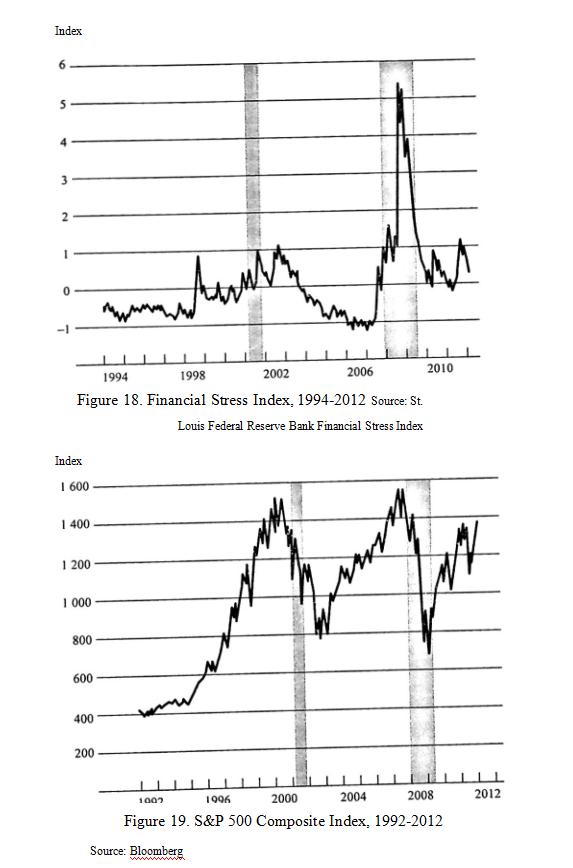
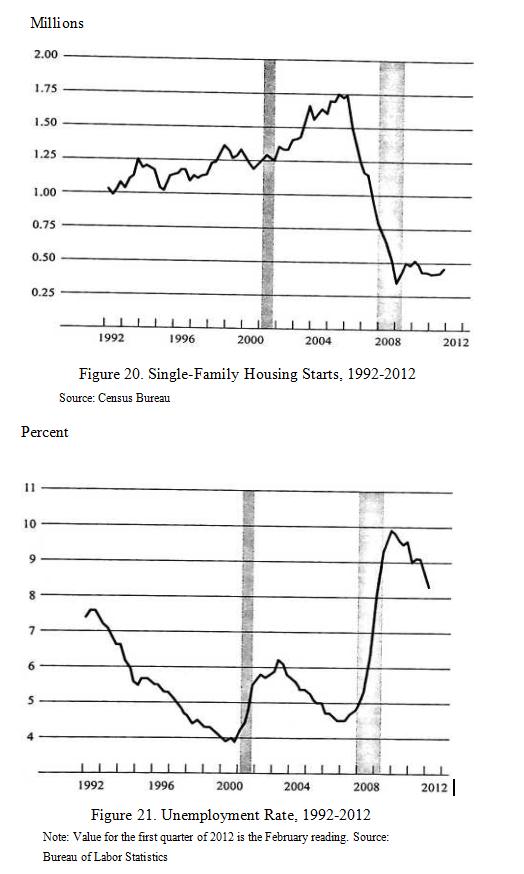
What were the consequences of the crisis? The economic consequences were severe. Figure 18 shows a measure of financial stress. It is just an index that combines a variety of financial indicators that indicate that the financial system is under great stress. And you can see what happened in 2008 and 2009: a sharp increase in financial stress in the financial markets. Figure 19 shows that the stock mar-ket plunged. The first decline, in 2000 and the 2001 recession, was a very large decline in tech stocks, but notice that the decline in the stock market in the more recent recession was even bigger than the one in 2000 and 2001. Figure 20 shows home construction. You can see the very sharp decline there. Home construction fell before the recession; of course, it was a trigger of the crisis. But looking to the right, you can see that it still has not really begun to recover. And then finally, figure 21 shows that unemployment rose very sharply, peaked around 10 percent, and has currently fallen to about 8.3 percent.
Dialogues
Student: In the previous lecture, you discussed that in the Depression, it seemed that policy was tightened too early and that led to a double dip. And then today, we were discussing that policy in the 1970s was too slow to tighten. How
do we know when the right time is? And is there a right time or does it vary all the time?
Chairman Bernanke: It is challenging, and that is certainly one of the reasons that the Fed has so many economists and models and everything to try to figure out what the appropriate moment is to tighten or to ease policy. Forecasting is not very accurate, and so we have to keep looking at what is happening and make adjustments as we go along. The 1970s was particularly difficult because at that time inflation expectations were not at all tied down. If gas prices went up, then people began to expect higher inflation and then to demand higher wages to compensate for the higher prices. And then, of course, higher wages would feed into higher prices, and so on. That was a result of the fact that everybody expected inflation to go up; nobody had any confidence that the Fed or the government in general would keep inflation low and stable. We have a very different situation now, fortunately-and this owes a lot to Chairman Volcker and to Chairman Greenspan as well. After a long period of low inflation, most people are pretty comfortable that inflation will stay reasonably low despite the fact that there are ups and downs with gas prices and so on. That helps a lot because, with inflation staying low, the Fed has more leeway. If policy is easy for a period, that is not necessarily going to feed into a wage-price spiral that would create a much bigger inflation problem down the road. So, keeping inflation expectations low and stable is one of the great accomplishments of Chairman Volcker and Chairman Greenspan, and it is an important objective of central banks around the world.
Student: I have a question about the low interest rate monetary policy in the early 2000s and your view, with all the different research that was conducted, that it did not spark the housing bubble. If you had been Fed chairman in 2001, would you have kept rates that low? Do you think it was the correct thing to do?
Chairman Bernanke: I was on the Fed Board during that time and the very first speech 1 wrote when I became a governor in 2002 was about bubbles and financial supervision and regulation. The theme of my speech was “use the right tool for the job.”The problem with tying interest rate policy to perceived bubbles and asset prices is that it is like using a sledgehammer to kill a mosquito. The problem is that housing is only one part of the economy, whereas interest rates are dedicated to achieving overall economic stability. So we estimate that in order to stop the increase in house prices, interest rates would have had to be raised very dramatically in a period when the economy was very weak. Unemployment was still above normal. Inflation was falling toward zero. And generally speaking, the right way to use monetary policy is to achieve overall macroeconomic stability. Now that does not mean you should ignore financial imbalances. I think the Federal Reserve could have been more aggressive on the supervisory and regulatory side to make sure, for example, that the mortgages being originated were of better quality, that firms were appropriately monitoring their risk, and so on. So 1 think the first line of defense should be regulation and supervision. One of the lessons I talked about today was no humble. For that reason, I think we should never rule out the possibility that, if all of our regulatory and other types of interventions do not achieve the stability and the financial system we want, monetary policy might, as a last resort, be modified to some extent to deal with that problem. But again, because monetary policy is such a blunt tool, which affects all asset prices and affects the entire economy, if you can get a laser-focused type of tool, that is going to be much better for everybody.
Student: At the end of the lecture you mentioned the role that global imbalances played in creating the housing bubble. Doesn’t the current U.S. monetary and fiscal policy, which focuses on boosting consumption through borrowing more?doesn’t that lead us down the same road of overconsumption through borrowing that got us into the crisis in the first place?
Chairman Bernanke: First, we would like to get a better balance in general, so monetary policy stimulates capital formation as well. It also tends to promote exports. So we would like to get a better balance of consumption, investment, and exports, as well as government spending-those are the main components of demand. So current monetary policy is consistent with a better balance. That being said, consumer demand is now far below where it was before the crisis. Consumer spending has not recovered. It is still quite weak relative to where it was before the crisis. Private debt has come down quite a bit. And you mentioned global imbalances, so we are talking about the current account imbalance, or the trade deficit, that the United States has. It has come down quite significantly. So all those things have moved, if anything too far in the short run because we lack a source of demand to keep the economy growing. I agree that every country needs to have an appropriate balance of consumption, capital formation, exports, and government spending, and that is an important task for us. But right now, debt and consumption and so on are still quite low relative to the pattern before the crisis.
Student: The latter part of your lecture was about monetary policy in the 2000s after the dot-com bubble and how interest rates were kept low. You argued that that was not a trigger to the increase in house prices. But to look at it from another point of view, what is your take on the argument that the low interest rates caused private investors and banks to make riskier trades, and that could have been a trigger to the crisis?
Chairman Bernanke: That is a good question. 1 think there is some effect of low interest rates on risk taking. But, once again, it is an issue of getting the right balance. During a recession, generally speaking, on most dimensions, investors become very cautious. That is certainly where they have been for much of the recent past. You want to achieve an appropriate balance between the amount of risk being taken-not too much, not too little-and once again, this is yet another reason why financial supervision and regulation needs to be playing a role. Particularly with large institutions-banks-we need to be looking directly at those firms and making sure that they are managing their risks appropriately. So, again, it is a question of the right tool for the job.
Student: The graphs on the housing bubble show how, clearly, one thing led to another, like rising prices and then eventually a fall. When you were observing rising house prices in the housing bubble? Did you think that it would eventually lead to a recession? There is a book called The Big Short about some investors who were very prescient in shorting the market. What is your take on that?
Chairman Bernanke: As I tried to argue, the decline in house prices by itself was not obviously a major threat. In 2005, when I was the chairman of the Council of Economic Advisers for President George W. Bush, we did an analysis for him on what would happen if house prices came down. We concluded that we would have a recession, but we did not anticipate that the decline of house prices would have such a broad-based effect on the stability of the financial system. When I became chairman of the Federal Reserve in 2006, house prices were already declining. In the first two weeks after I became chairman, I gave testimony in which I said: house prices are falling; that is going to have negative impacts on the economy and we are not sure of all the consequences. So we were always aware of the possibility that house prices might come down. The really hard thing to anticipate fully was that the effects of the decline in house prices would be so much more severe than the effects of the somewhat similar decline in dot-com stocks. And again, the reason is the way in which the decline in house prices affected mortgages, which affected the soundness of the financial system and created a panic, which in turn led to the instability of the financial system. So the whole chain of events was critical. It was not just the decline in house prices; it was the whole chain.
Student: Amid the dispersion of cheap credit in the years preceding the housing crisis, there was a bipartisan push for American homeownership, originally spearheaded by President Bill Clinton and later carried on by President George W. Bush. To what degree could it be argued that that aggressive government policy supporting increased lending during this period contributed to the eventual erosion of credit standards on behalf of the mortgage originators?
Chairman Bernanke: That is a very good question, and another controversial one. Certainly, there was some pressure to increase homeownership. There was the American dream aspect of owning a home and so on. Homeownership rose during this period. But to put all the responsibility on the government is probably wrong in this case. Most of the worst loans were made by private-sector lenders and then sold for privatesector securitization, that is, they did not touch Fannie Mae and Freddie Mac. For example, they went directly to investors. Fannie and Freddie did acquire some subprime mortgages, but actually that was a little bit later in the process rather than at the beginning of the process. But clearly the private sector, without any encouragement from the government, was a big player in the decline in mortgage underwriting standards and in the selling of bundled mortgages to private investors.
Student: I think one of the hallmarks of the Fed under your leadership has been your commitment to transparency. All of us in this room are beneficiaries of that policy. But I wonder whether you think too much transparency could actually damage the central bank抯 credibility, if it gets things wrong.
Chairman Bernanke: Generally, I agree that transparency is very important for at least a couple of reasons. I talked already about the importance of a central bank being independent. So there is one linkage there. But if a central bank is independent and making important decisions that affect everybody, then it has to be accountable. People have to understand what it is doing, why it is doing it, and on what basis it makes its decisions. So for democratic accountability, I think it is important for the central bank to be transparent. I testify all the time, I give speeches, I have town hall meetings and other kinds of meetings like this, I give press conferences, and I think it is very important for me to explain what the Fed is doing and why it is doing it. The other reason for transparency is that, over time, there has been increased understanding that most of the time, transparency can make monetary policy work better. So, for example, if the Federal Reserve communicates that its future actions will be X or Y and conveys that information to the markets, the markets may respond by building those expectations into interest rates, which may have a more powerful effect in the economy. So communication also reduces uncertainty and helps increase the impact of monetary policy in financial markets.
Student: My question concerns price stability and inflation expectations. You mentioned the importance of macroeconomic stability and long-run economic growth. Given the massive amount of liquidity that has been pumped into the market recently, how has the Fed been able to keep inflation expectations so low?
Chairman Bernanke: 1 think we owe something to my predecessors?Chairman Volcker, in particular, and also Chairman Greenspan-who got inflation down low and kept it there. People get used to what they see. And in a world in which inflation remains low year after year, people become more and more confident that the central bank-the Fed or whoever will meet its mandate of keeping inflation low. It has been very striking that, even though we have had movements in oil prices and other shocks to the economy, deep recession and financial crisis, throughout most of the period inflation expectations have been very well tied down to about the 2 percent range that the Fed is trying to hit.